

vestibular system


 1
6.3
1
6.3
- noun
- /vɛˈstɪbjʊlər ˈsɪstəm/
- Specialized
- The vestibular system has both a sensory and a motor function:
- vestibular system and the associated
Loading YouTube…
Watch on YouTubeSo moving your body slowly is actually very disruptive to the to the vestibular system and it's very disruptive to your visual system.
- So moving your body slowly is actually very disruptive to the to the vestibular system and it's very disruptive to your visual system.
Examples
-
The auditory and vestibular systems and the facial nerve are at risk.
Academic text (2004) -
Indeed, a functioning vestibular system is necessary for the perception of motion sickness.
Academic text (2005) -
Because the vestibular system senses head motion, it is less sensitive to body sway than the visual or the somatosensory system.
Academic text (1999) -
The vestibular system measures the head's angular velocity and linear acceleration and detects head position relative to the gravitational axis.
Academic text (1999) -
The inertial-gravitational reference provided by the vestibular system is critical to the resolution of sensory conflicts between visual and vestibular inputs and between spinal and vestibular inputs.
Academic text (1999) -
The vestibular system is crucial for keeping our balance while walking on uneven surfaces.
-
During the experiment, we monitored how the vestibular system affected the participants' coordination.
-
A healthy vestibular system allows people to move smoothly and maintain orientation without dizziness.
Synonyms
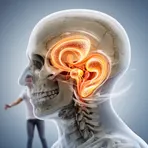
Parts in the inner ear that help keep balance and show where your head is
Surface Forms
Morphology
The meaning is directly and compositionally derived from 'vestibular' (connected to the inner ear and balance) + 'system' (an ensemble of organs); a learner who knows both constituents can infer it denotes the bodily system for balance and spatial orientation. Although somewhat technical, the adjective+noun structure and cross-linguistic parallels make the relation transparent rather than idiomatic.
Etymology
Vestibular system comes from the old word 'vestibule', meaning a small entrance or hall, and the parts vestibular and system point to a group of parts in the inner ear. Inside the ear, tiny fluid-filled chambers and little stones move when you turn or tilt, and those movements tell the brain about your 'balance', so the name links those 'little halls' to the idea of keeping steady.