
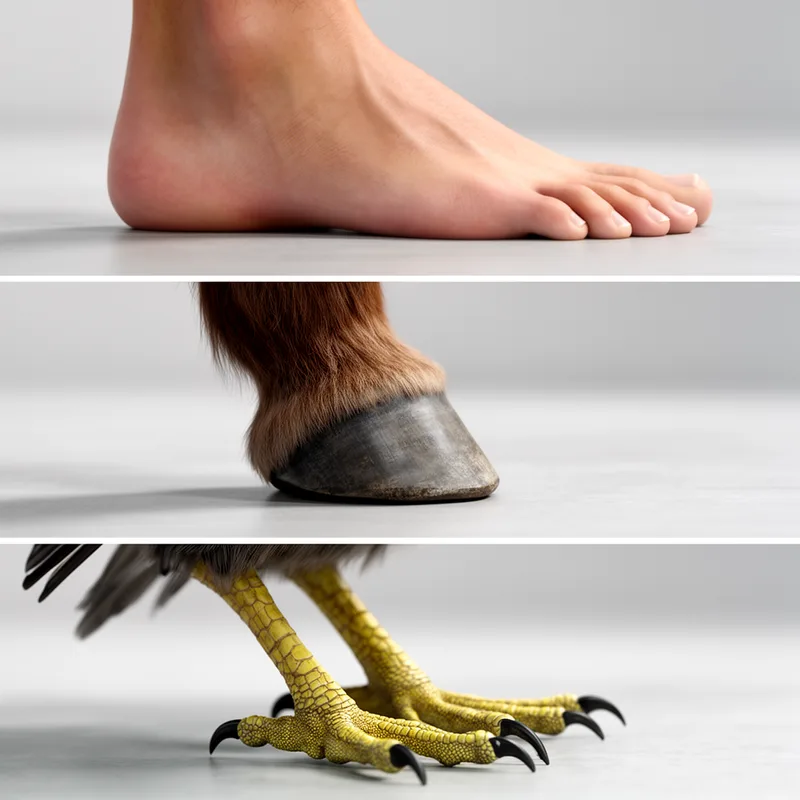
vertebrate foot
- noun
- /ˈvɜrtəbrɪt fʊt/
- Specialized
- The structure of a vertebrate foot varies greatly among species, from hooves to claws to human feet.
Examples
-
The fossilized vertebrate foot provided valuable insight into how ancient animals moved.
-
Researchers studied the bones and muscles in the vertebrate foot to understand evolutionary changes.
-
The vertebrate foot is essential for locomotion.
-
Birds have a unique structure in their vertebrate feet.
-
The structure of a vertebrate foot can include digits and claws, which help animals adapt to their environments.
-
Many vertebrate species, such as mammals and birds, have evolved unique adaptations in their vertebrate foot for different habitats.
-
A flexible vertebrate foot allows animals to run quickly on various terrains, enhancing their survival skills.
Synonyms

 ∞
1.0
∞
1.0

The lower part of the leg below the ankle that supports standing and walking

The foot and toes at the end of a leg

The lowest part of an animal's leg used for standing or walking
Surface Forms
Morphology
The meaning is directly and literally compositional: 'vertebrate' specifies the kind of animal (backboned) and 'foot' names the terminal limb part used for standing or moving. This straightforward noun+noun combination follows common cross-linguistic naming patterns, so a B1 learner who knows both constituents will readily understand the MWE.
Etymology
Vertebrate foot is a plain, literal name: vertebrate means an animal with a backbone and foot is the end part used to stand or move. So the phrase points to the 'end of a limb' on animals with a backbone and means the part they use for standing or moving.