

ventricular fold
- noun
- /vɛnˈtrɪkjʊlər foʊld/
- Specialized
- The ventricular fold in the larynx serves to protect the vocal cords, keeping them safe from injury.
- left ventricular fold
Examples
-
Computed tomography (CT) confirmed the presence of a soft tissue mass at the left ventricular fold, which extended into the ventricle (Figure 1).
Academic text (1998) -
The patient had developed a submucosal lesion in the left ventricular fold, which was removed by surgical microlaryngoscopy.
Academic text (1998) -
During the routine otolaryngologic examination, a massive hypertrophy in the left ventricular fold of the larynx was discovered.
Academic text (1998) -
Indirect laryngeal mirror examination revealed an expansion of the hypertrophic left ventricular fold, which resembled a submucosal tumoral mass.
Academic text (1998) -
During the examination, the doctor noted swelling in the patient's left ventricular fold that could affect their voice.
-
Surgical intervention was necessary to address the growth in the ventricular fold above the true vocal cords.
Synonyms


 1
8.9
1
8.9
An upper fold of tissue in the throat that does not make sound

A fold of tissue in the voice box that protects the airway and does not make speech sounds

One of two thin pieces of tissue above the voice box that do not make sound
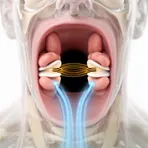
Upper throat folds that protect the airway but do not make sound
Surface Forms
Morphology
The phrase is compositionally formed from 'ventricular' (relating to a ventricle) + 'fold' (a doubled-over ridge), so a learner could infer it means a fold related to a ventricle. However, the specific referent (the ventricular/vestibular folds of the larynx) is a technical anatomical usage and 'ventricular' is commonly associated with heart or brain ventricles, so the exact meaning and location are not fully predictable to a B1 learner.
Etymology
Ventricular fold is a literal name: ventricular points to a small pocket and fold means a bent piece of tissue in the voice box. These folds sit above the true vocal cords and usually do not vibrate to 'make sound', so the name shows where they are and why they do not help with speaking.