

vena pulmonalis
- noun
- /ˈviːnə pʌlˈmoʊnəlɪs/
- Specialized
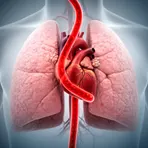
- The vena pulmonalis transports oxygen-rich blood from the lungs to the heart's left atrium.
Examples
-
The vena pulmonalis transports oxygen-rich blood from the lungs to the heart.
-
The vena pulmonalis carries oxygenated blood from the lungs.
-
Impaired flow in the vena pulmonalis can lead to serious circulatory problems.
-
Medical students studied the anatomy of the vena pulmonalis during their cardiology module.
-
There are four vena pulmonales in the human body.
-
Medical students studied the anatomy of the vena pulmonalis to understand its role in pulmonary circulation.
-
Impaired flow in the vena pulmonalis can lead to serious circulatory problems affecting the heart.
Synonyms
 1
3.8
1
3.8

A vein that carries oxygen-rich blood from the lungs to the heart
Surface Forms
Morphology
vena + pulmonalis
If a learner knows 'vena' as a blood vessel and 'pulmonalis' as 'of the lung' (cognate with English 'pulmonary'), the meaning 'vein of the lung that carries oxygenated blood to the heart' is directly derivable from the parts. Although a technical Latin medical term, the composition is morphologically regular and has clear cross-linguistic cognates, so its sense is transparent to learners who know both constituents.
Etymology
Vena pulmonalis comes from Latin and literally means vena ('vein') of pulmonalis ('lungs'). Picture a tube from each lung carrying 'oxygen-rich blood' back 'to the heart', which is why the term names the veins that do this.