
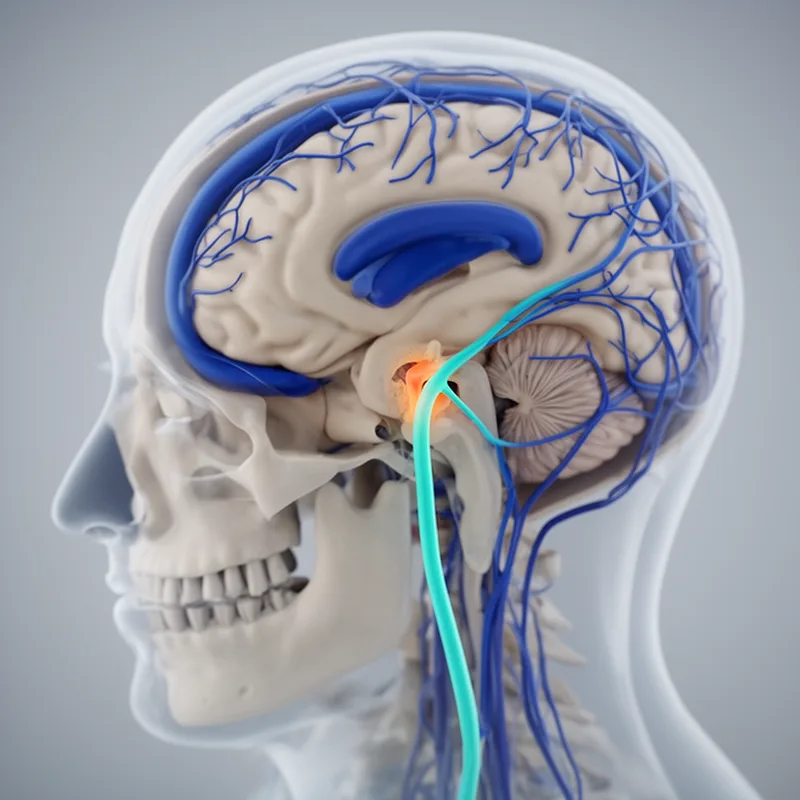
vena emissaria
- noun
- Specialized
- The vena emissaria plays an important role in draining blood from inside the skull to the outside.
Examples
-
The surgeon carefully avoided the vena emissaria during the cranial procedure.
-
Infections can sometimes spread through the vena emissaria due to its connection between the scalp and intracranial structures.
-
The vena emissaria plays a crucial role in cranial venous drainage.
-
In anatomy class, we learned about the vena emissariae and their functions.
-
The vena emissaria allows blood to flow from the inside of the skull to the outside, making it crucial for cranial circulation.
-
During the autopsy, the doctor examined the vena emissaria to understand its role in the body's venous system.
-
Understanding the function of the vena emissaria is essential for medical students studying human anatomy.
Synonyms
A blood vessel in the head that connects veins inside the skull to veins outside
Surface Forms
Morphology
vena + emissaria
The first element 'vena' clearly means 'vein' and 'emissaria' derives from the Latin root meaning 'to send out' (compare English 'emissary'), so a learner who knows both could infer this refers to a vein that sends/lets blood out or connects to other vessels. However, the precise anatomical function — connecting intracranial sinuses with extracranial veins — is technical and not fully predictable from the parts alone, and 'emissaria' is a specialist/Latin-form term, so understanding would be partial rather than immediate.
Etymology
Vena emissaria comes from old Latin words: vena meaning 'vein' and emissaria meaning 'one that sends out'. These are small veins like tiny pipes that go from inside the skull to the scalp, so they can let blood or infection move out of the head. That's why the name is used for veins that connect the inside and outside of the skull.

