

to uprear
- verb
- /ʌpˈrɪr/
- Archaic
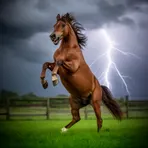
- When startled by the noise, the horse would uprear and paw at the air.
Examples
-
The frightened dog began to uprear when it saw the stranger approaching.
-
Why did the horse uprear so suddenly?
-
The statue seemed to uprear above the crowd, towering over everyone in the square.
-
The horse upreared suddenly.
-
The startled deer suddenly uprear on its hind legs to get a better view of its surroundings.
-
When the drummer struck the cymbals loudly, the horse began to uprear in surprise.
-
During the performance, the stallion would uprear majestically for the audience.
Synonyms

 220
1.0
220
1.0

To rise or move to a higher position
 107
1.1
107
1.1
To raise someone or something to a higher place
 28
4.9
28
4.9
To rise up on the back legs, often when frightened
 7
2.1
7
2.1
To lift something or someone to a higher place
 1
4.9
1
4.9
Stand up on the back legs, often suddenly from fear or excitement
 1
7.5
1
7.5
Rise up on the hind legs, lifting the front of the body
Antonyms

How High

Surface Forms
Morphology
uprear = rear (transparent) = up + rear
The intransitive sense is essentially 'rear' with an added directional 'up-', so the motion is clearly signalled by the prefix.
Etymology
The word uprear joins up- ('higher') and rear ('to rise or lift'), and it brings to mind a horse lifting its front legs and standing taller. That's why to uprear can mean to rise up suddenly or to lift the front of the body.