

uncaused
 1
9.9
1
9.9

- adjective
- /ˌʌnˈkɔːzd/
- His own conclusion is "not that God is self-caused, but rather that God is uncaused."
Loading YouTube…
Watch on YouTubeAnd we never come across things coming into being uncaused.
- And we never come across things coming into being uncaused.
- You could say almost like, well, I mean, even classical theism don't say that God produces whatever God is, just that God is an uncaused cause.
Examples
-
The sorts of arguments you are talking about conclude that God is an uncaused cause.
Blog text (27) -
One shouldn't confuse the fact that an action is undetermined with the fact that it is uncaused.
Blog text (20) -
The argument for the necessity of an uncaused cause is a sound one.
Blog text (14) -
Ergo, thinking of free will as something uncaused is a mistake.
Blog text (20) -
And here is a modern bishop: "The uncaused self-existent Eternal is indeed One, One God."
Academic text (2017) -
The Wave Function of the Universe implies that there is a 95% probability that the universe came into existence uncaused.
Blog text (2) -
Quantum mechanics has convinced most physicists that uncaused events can occur.
Blog text (12) -
The take-home message is that Quentin currently holds to a self-caused universe, not an uncaused universe.
Blog text (2) -
And this impossibility of a past-infinite elapse of time indicates an uncaused original world with no succession of time.
Blog text (26) -
Many philosophers argue that the universe must have an uncaused origin to explain its existence.
Synonyms
 62
4.8
62
4.8
No one knows the cause
 23
6.5
23
6.5
Happening for no clear reason
 1
9.3
1
9.3
Existing without a beginning or cause


 1
8.2
1
8.2
Happening for no clear reason
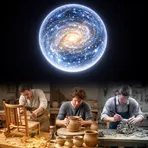
Has no cause or maker
Surface Forms
Morphology
uncaused = caused (transparent) = un + cause + ed
The productive negative prefix 'un-' is applied to the past participle/adjective 'caused', yielding a straightforward negated meaning 'not caused'.
Etymology
The word uncaused is made from un- ('not') plus cause ('reason' or 'source'), and you can see cause in the familiar word because. So, uncaused means 'not produced by something else' or 'without a clear reason'.