

unbroken
 1
5.7
1
5.7

- adjective
- /ʌnˈbroʊkən/
- The hike led us to a stunning view of the unbroken valley, filled with wildflowers and grass.
Examples
-
As we walked through the unbroken field, we marveled at the beauty of nature untouched by farming.
-
Confronted with pristine wildernesses and unbroken prairies, early settlers naturally focused on taming and exploiting the land, not on protecting it.
Academic text (1998) -
For as far as the eye could travel, the land was unbroken by even a hillock.
Academic text (2016) -
Grass as far as the eye could see, unbroken except for patches of bush here and there on a hill.
Fiction book (1992) -
CVRD and several cooperating federal agencies actively planned development in this area of virtually unbroken rainforest.
Academic text (1992) -
Blackledge rose above them to either side, craggy and misted, stretching in an unbroken wall until it disappeared into the horizon.
Fiction book (1992) -
Where the windblown rock tapered into snow at the edge of the low ridge, an unbroken expanse of hard-crusted snow extended to the south.
Fiction book (1992) -
Gradual inclines rose to the irregular peaks—all of them deep in a mantle of unbroken white.
Fiction book (1992) -
The world below, Coruscant, former throne world of the Empire, was an unbroken landscape of urban construction, a vast city reaching from pole to pole, blanketed by gray clouds shot through with white and yellow flashes of lightning.
Fiction book (1998) -
After hours of driving, we finally reached the unbroken stretch of land that seemed to go on forever.
Synonyms
 11
3.9
11
3.9
Not damaged or rotten and still in a fresh, natural state
 3
3.7
3
3.7
Not changed by what other people or things do
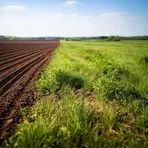 1
6.2
1
6.2
Land that is not turned over to make the soil ready for planting


 1
5.1
1
5.1
Land that is not prepared for growing crops
Antonyms

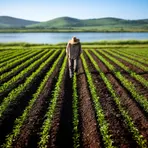
How Cultivated

Surface Forms
Morphology
unbroken = broken (semi-transparent) = un + break + en
Built by negating 'broken' in the agricultural sense 'plowed/cultivated'; this domain-specific sense may not be known to all learners.
Etymology
Unbroken is made of un- meaning 'not' and broken from 'break', and farmers used 'break' to mean plow the soil, so unbroken land has not been plowed and stays in its natural state.