
turnpike
 1
9.8
1
9.8

- noun
- /ˈtɜrnˌpaɪk/
- Archaic
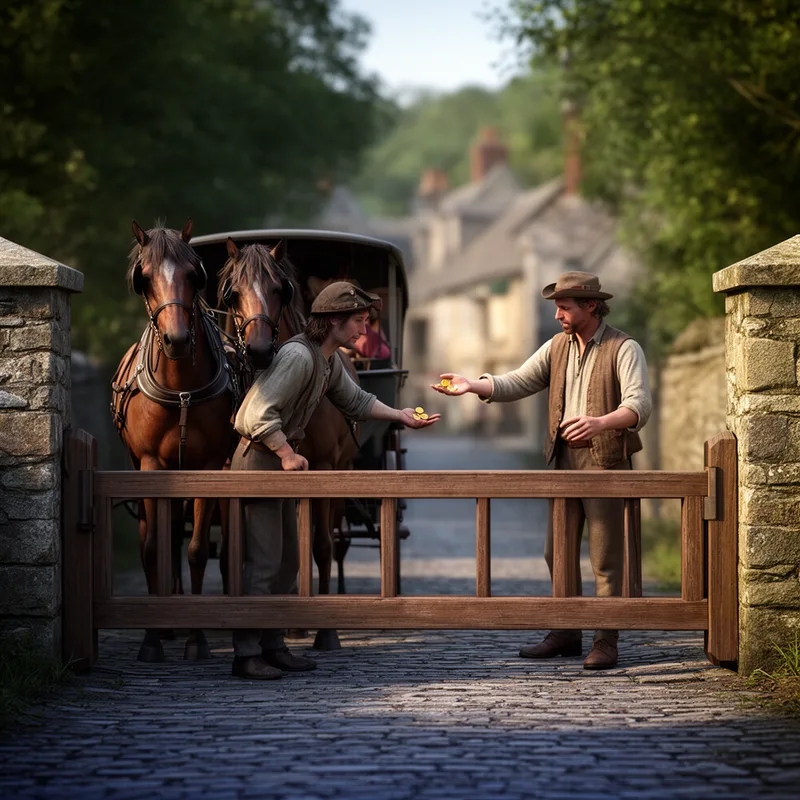
- In the 18th century, travelers had to stop at a turnpike to pay a toll before continuing their journey.
Loading YouTube…
Watch on YouTubeand went through a Turnpike where the guys with the guards let us in.
- and went through a Turnpike where the guys with the guards let us in.
Examples
-
The historical records show that a turnpike was placed at the entrance to the town to control access.
-
Turnpikes and stagecoaches were controversial in England.
Academic text (2007) -
Check the turnpike, Al. -
-
and went through a Turnpike where the guys with the guards let us in.
-
Marino asked, "You notice the turnpike's less than a mile from here?"
Fiction book (1990) -
Though if Tom had wanted one at any time, there was not a man or boy in all the village, and away to the turnpike (toll-man included), but would have blown away for him till he was black in the face.
Academic text (2010) -
There were repeated battles with turnpike trusts to keep open ancient rights of way and to remove road chains and bridge tolls until the powers of township boards of highway surveyors were abolished in the Leeds Improvement Act of 1866.
Academic text (1993) -
Many cities built turnpikes to generate revenue for road maintenance during the 19th century.
Synonyms
 1
5.1
1
5.1
A gate across a road where drivers pay a fee to pass

A bar across a road or bridge that lifts after payment
Surface Forms
Morphology
Etymology
Turnpike originally meant the gate itself: it was a long pole called pike, a 'spear' or 'long pole', that could be 'turned' to block the road, and guards would collect a toll there.