

to turn out
 17
3.5
17
3.5

- phrasal verb
- /tɜrn aʊt/
- Enterprising Chinese forgers, using molds from the ruins of ancient kilns, quickly turned out look-alikes.
Loading YouTube…
Watch on YouTubeYou're working at a shop that intends to turn out perfect stuff.
- You're working at a shop that intends to turn out perfect stuff.
- And he explains the kind of high concept scripts that he had to turn out and writing one for the Olsen twins.
Examples
-
The Curtiss Jenny was the first mass-produced airplane, with 6,000 turned out between 1915 and 1918.
Academic text (2003) -
Young estimates that Marble Systems turns out a million square feet of natural stone every year.
Blog text (20) -
Petroleum refineries also turn out jet fuel, heating oil, propane, and other products.
Academic text (2004) -
At one point, more than 80 factories in the United States turned out airframes and airplane components, from propellers to engines.
Academic text (2005) -
About 100,000 of them were enlisted to turn out some 2 million eggs—about 50 grams worth.
Academic text (2005) -
The factory can turn out thousands of toys each day to meet holiday demand.
-
In just a few hours, the bakery will turn out hundreds of fresh loaves of bread.
-
Our workshop is equipped to turn out customized furniture quickly and efficiently.
Synonyms
 ∞
2.0
∞
2.0
To make something, often in large amounts for sale
 183
3.6
183
3.6
To produce something, often a profit or result
 162
3.3
162
3.3
To make many things using machines
 21
4.0
21
4.0
To make large amounts quickly with little care
 16
4.0
16
4.0
To make many things quickly, often without much care
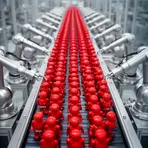 8
3.5
8
3.5
To make large amounts of goods using machines and the same steps
Antonyms


How Productive
8
3.5

- Informal
21
4.0
17
3.5
∞
2.0
∞
1.0
Surface Forms
Morphology
The dressing sense is only partially derivable from the constituents: 'turn' (change) + 'out' (outward) can be linked to altering outward appearance, but the specific meaning 'dress/equip someone' depends on knowing the phrasal-verb usage rather than pure composition. Because 'turn out' has several unrelated senses and the connection to clothing is metaphorical and not fully predictable, a B1 learner who only knows the words may not reliably infer this meaning.
Etymology
Turn out likely comes from workshops and factories that would turn goods out the door when they were finished, producing many items to sell. That's why it means 'to produce' something quickly or in large amounts.