

turkey vulture
 3
6.0
3
6.0

- noun
- /ˈtɜrki ˈvʌltʃər/
- US
- Tomorrow, we're releasing Molly the turkey vulture back into the wild.
- turkey vultures circling
- turkey vultures soar
- turkey vultures flew overhead
Examples
-
The turkey vulture soars.
Fiction book (2001) -
Three turkey vultures circled in the sky over the Graycloud land.
Fiction book (1990) -
After a couple of hours of watching, I'm learning a lot about turkey vultures.
Blog text (26) -
"Once upon a time, there was a turkey vulture who lived in Austin, Texas."
Fiction book (1995) -
She's a young turkey vulture.
-
And your neighborhood has not been overrun by wild turkey vultures.
Blog text (15) -
A turkey vulture perching is about two and a half feet tall, and this cage was only two feet four inches high, so he had to keep his head bent over to one side.
Fiction book (1995) -
In honor of IVAD, we released a rehabilitated turkey vulture at Cooper's Rock State Forest, and Laurel's picture made the front page of the newspaper.
Blog text (26) -
We watched a clan of turkey vultures execute spiraling descents before settling for the night in a eucalyptus tree.
Blog text (2) -
High in the sky, a turkey vulture slowly circled, its white-tipped wings spread wide as it searched for food.
Synonyms
 42
3.3
42
3.3
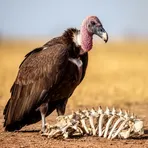
A large bird with a bare head that eats dead animals
 4
5.9
4
5.9
A large bird that eats dead animals and is found in North and South America


 1
7.8
1
7.8
A large bird with a red bald head that eats dead animals
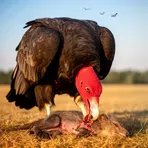
A large American vulture with a red head that eats dead animals
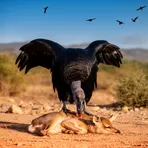
A large black vulture that eats dead animals in the Americas

A group of large vultures in the Americas that includes the turkey vulture

A large bird like a vulture that eats dead animals in the Americas

A large bird in the Americas that eats dead animals and often has a bare head
Surface Forms
Morphology
The compound 'turkey vulture' transparently names a kind of vulture associated with or resembling a turkey: combining the known nouns 'turkey' and 'vulture' signals a specific vulture species. This noun–noun composition is a standard, cross-linguistic way to form animal names, so a B1 learner who knows both constituents would readily infer the meaning.
Etymology
The compound noun turkey vulture may come from early settlers who thought the bird's red, bare head looked like a turkey's head. So the name pairs turkey with vulture to describe a large bird that eats 'dead animals'.