

New World vulture
- noun
- /nuː wɜrld ˈvʌltʃər/
- US
- The New World vulture has an excellent sense of smell, unlike its Old World counterparts.
Examples
-
Some South American farmers believe that the presence of a New World vulture is a sign of good fortune.
-
Look at that New World vulture!
-
Conservationists are working to protect several species of New World vulture from extinction.
-
The New World vulture is often seen soaring high in the sky.
-
The New World vulture circles high in the sky, searching for carrion to eat.
-
One characteristic of the New World vulture is its strong sense of smell, which helps it locate dead animals.
-
In the Americas, the New World vulture plays a vital role in the ecosystem by cleaning up dead animals.
Synonyms
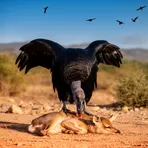
A large black vulture that eats dead animals in the Americas

A large bird like a vulture that eats dead animals in the Americas
Surface Forms
Morphology
The noun 'vulture' plus the modifier 'New World' signals a vulture associated with the 'New World' (the Americas), so a learner who knows the constituent words can generally infer a geographical sense (a vulture from a particular region). However, 'New World' is a conventional historical/biogeographical label rather than a literal composition, and the specific taxonomic contrast with 'Old World vultures' is not deducible from the words alone, making the relation only partially predictable.
Etymology
New World vulture comes from early explorers who called the Americas the 'New World' and used New World to show where the bird lived and vulture for a bird that eats dead animals. That's why the name means 'a large bird from the Americas that looks like Old World vultures but belongs to a different bird family'.

