
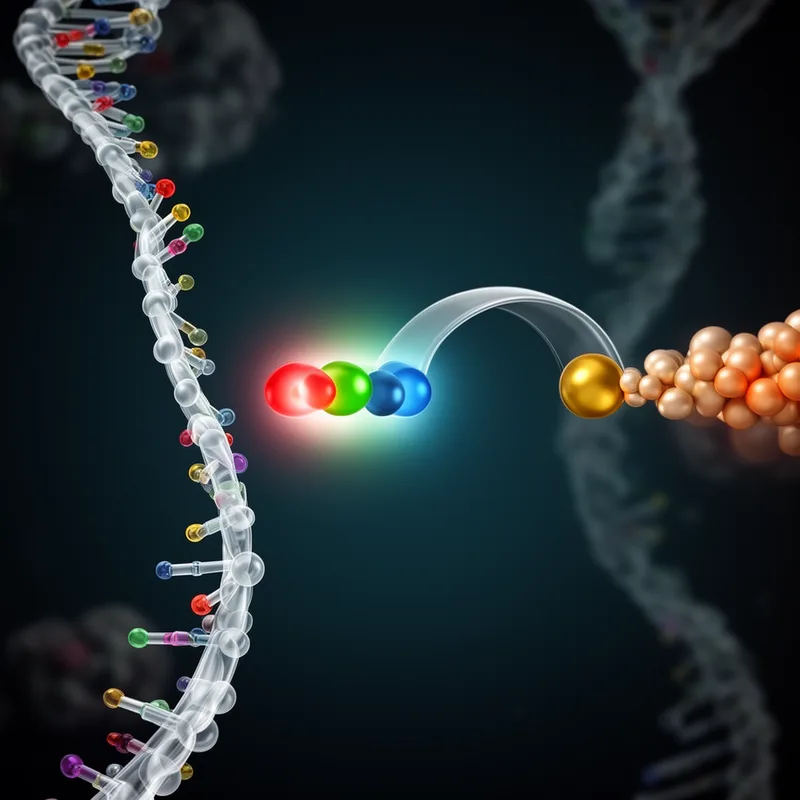
trinucleotide
- noun
- /ˌtraɪˈnʌklɪˌtaɪd/
- Specialized
- The codon models constitute a special case of independent tuple models where sequence states that correspond to stop codons are excluded from the state space. For example, a codon model for the standard genetic code has 61 states corresponding to the sense codons, 3 states less than the full trinucleotide state space of 64.
Examples
-
In molecular biology, researchers study the function of a trinucleotide as a coding unit within RNA.
-
We present the NF and TF models for dinucleotides, but note that essentially the same treatment applies to trinucleotides and larger units.
Blog text (25) -
The mutational processes are represented by distinct patterns of frequencies of trinucleotide sequences surrounding the base of substitution, which is also known as the somatic mutational signatures 11.
Academic text (2018) -
The sequence of three nucleotides, known as a trinucleotide, can code for a specific amino acid in the genetic code.
-
Certain genetic disorders are linked to abnormal expansions of specific trinucleotide repeats within DNA sequences.
Synonyms
 2
7.8
2
7.8

Three DNA or RNA letters that tell the cell which amino acid to add or to stop making protein
Surface Forms
Morphology
trinucleotide = nucleotide (transparent) = tri + nucleotide
Formed by the productive prefix 'tri-' (three) applied to the established biomedical term 'nucleotide', yielding the literal meaning 'three nucleotides'.
Etymology
Trinucleotide comes from tri- meaning 'three', as in triangle or tricycle, and nucleotide meaning a small 'unit' of DNA or RNA. So a trinucleotide is a group of three such units that often 'codes' for one amino acid.