
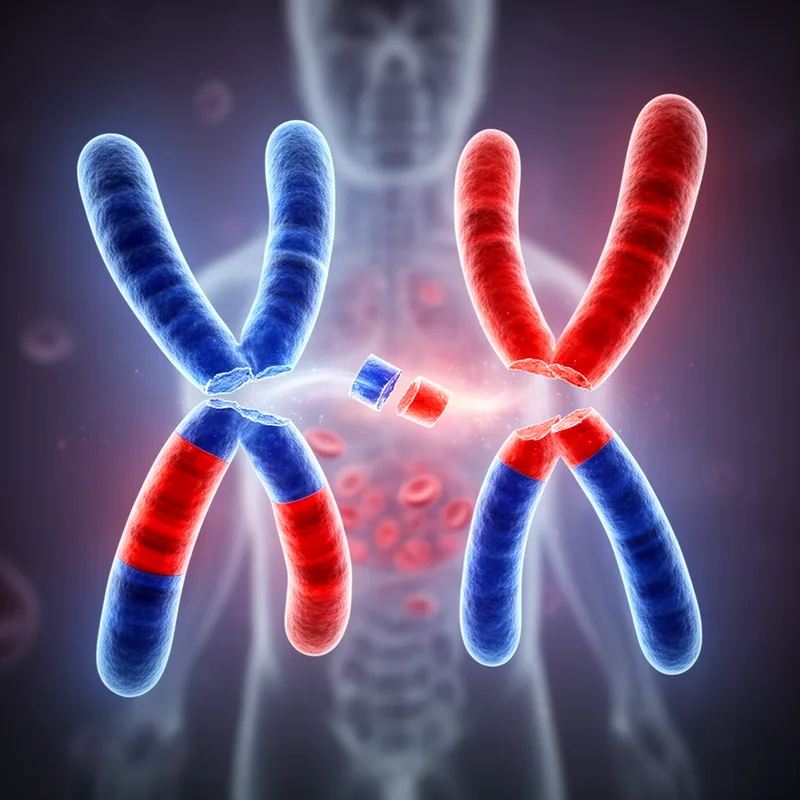
translocation
 1
9.5

- noun
- /ˌtrænzloʊˈkeɪʃən/
- Specialized
- Their telomeres became shorter than normal, their chromosomes broke, and some nonhomologous chromosomes fused to form translocations.
- result of translocation
Examples
-
The odd part about miscarrying for me was that my mom had only me, then developed genetic translocation, a chromosomal disorder where a woman can conceive a baby but cannot carry it to term.
Blog text (29) -
Here a translocation has taken place so that the structure of the chromosome is abnormal.
-
The 1990s witnessed an explosion of new knowledge about the genetics of cell-to-cell signaling and coordinated gene translocation for defense and virulence factors.
Academic text (2003) -
In the evolutionary context, Haldane deals for the first time with inversions and translocations, polyploidy, and hybridization.
Academic text (1992) -
Pediatric soft tissue sarcomas are rare tumors of childhood, frequently characterized by specific chromosome translocations.
Blog text (9) -
Because typical translocation could not be found in the FISH study, it was believed this may reflect a subgroup of peripheral PNETs (pPNETs), which lack this genetic change.
Academic text (2015) -
The alveolar type has consistently been marked by a translocation of chromosomes (2; 13) (q35q14); in the embryonal type, the maternal allele is lost.
Academic text (2005) -
Researchers discovered that the translocation of genetic material between chromosomes can lead to certain cancers.
-
The study of translocation in chromosomes helped scientists understand various genetic disorders.
-
A certain translocation was identified in the patient's genome, which contributed to their unusual symptoms.
Surface Forms
Morphology
translocation = translocate (semi-transparent) = trans + locate + ion
Formally 'trans-' + 'locate' + '-ion' (movement across places), but the genetic sense is a technical extension referring to exchange or relocation of chromosome parts, which is less immediately obvious to an average learner.
Etymology
Translocation comes from the parts trans- ('across') and locate ('place'). In genetics it means when parts of a chromosome have been moved 'across' to a new place, so imagining pieces being moved from one place to another on the chromosomes makes the meaning clear.