

timber hitch
- noun
- /ˈtɪmbər hɪtʃ/
- Specialized
- During the survival course, the instructor demonstrated how to use a timber hitch to attach the rope to the fallen tree.
Examples
-
"Get me two long pegs, pull the ropes, and tie a timber-hitch knot around the pegs."
Fiction book (1997) -
To secure the log for transport, he tied a timber hitch around it tightly.
-
When setting up the tent, she quickly used a timber hitch to secure the rope to the sturdy pole.
Synonyms

 95
1.0
95
1.0

A fastening made by tying rope or string to hold things together
 5
5.8
5
5.8
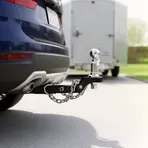
A device on a vehicle used to attach a trailer
 1
6.5
1
6.5
A simple knot that holds a rope by looping its end around an object


 1
8.5
1
8.5
A knot to fasten a rope to a post that is quick to tie and untie

A knot used to hold a rope to a ring or pole

A knot that ties a rope to a pole or another rope to stop it sliding one way

A strong knot used to tie a rope to a pole or another rope

A knot for tying one rope temporarily to the middle of another rope or to a loop

A simple knot that holds a rope on a hook for a short time
Surface Forms
Morphology
The meaning is directly and transparently derived from combining 'timber' (a log/wood) with 'hitch' (a knot used for securing); it literally denotes a knot used on timber for hauling or lifting. This straightforward noun+noun compositional pattern is common and predictable, so a B1 learner who knows both words should be able to infer the MWE's meaning.
Etymology
Timber hitch comes from the simple knot used to fasten a rope to a log: timber means a log and hitch means a quick knot. The loop tightens when you pull and holds the log, so the term now refers to the knot 'used to attach a rope to a log or pole'.