

clove hitch


 1
8.5
1
8.5
- noun
- /kloʊv hɪtʃ/
- Specialized
- He quickly used a clove hitch to attach the fishing line to the post.
Examples
-
To secure the sail on the boat, he tied a clove hitch around the mast.
-
While mooring the punt, Father showed me how to make a clove hitch with the mooring line around the branch.
Academic text (1997) -
Sheepshank, bowline, clove hitch...
-
While setting up the tent, she demonstrated how to make a clove hitch with the rope.
Synonyms
 1
6.5
1
6.5
A simple knot that holds a rope by looping its end around an object

A strong knot used to tie a rope to a pole or another rope
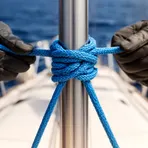
A knot that ties a rope to a pole or another rope to stop it sliding one way
How Secure
- Specialized
4
8.2

- Specialized
- Specialized
1
8.5
- Specialized
1
6.5
Surface Forms
Morphology
clove + hitch
The headword 'hitch' clearly signals a temporary knot, so a learner who knows 'hitch' will infer that the phrase names a type of knot. However, 'clove' does not transparently describe the specific form or use of the knot (it is a lexicalized, technical label rather than a compositional descriptor), so the precise meaning and usage are not predictable without prior exposure.
Etymology
Clove hitch gets its name from the knot's look: one popular story says the two crossing turns look like a small clove (a garlic segment) wrapped around a post. Because this shape makes a quick, simple hold that is easy to tie and untie, people used it for 'fastening a rope to a post' and the name stuck for this temporary knot.