

thysanuran insect
- noun
- /θaɪˈzænərən ˈɪnsekt/
- Specialized
- The thysanuran insect is easily recognized by its three long, bristly tails extending from the abdomen.
Examples
-
A thysanuran insect can often be found hidden under rocks and leaf litter in damp environments.
-
Scientists studied the molting process of the thysanuran insect to better understand primitive insect evolution.
-
The thysanuran insect is often found in damp environments.
-
Many thysanuran insects are nocturnal and feed on organic matter.
-
A thysanuran insect can often be found hidden under rocks and leaf litter in damp environments.
-
Scientists studied the molting process of the thysanuran insect to better understand primitive insect evolution.
-
The thysanuran insect is easily recognized by its three long, bristly tails extending from the abdomen.
Synonyms
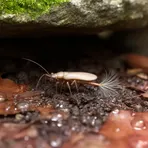
A small wingless insect with tiny hairs on its tail that lives in damp places

A small insect without wings that has a long bristle tail
Surface Forms
Morphology
thysanuran + insect
The modifier 'thysanuran' is a rare, technical taxonomic adjective with no common-dictionary gloss here, so its meaning is not transparently built from familiar English morphemes. Even though 'insect' is clear, a B1 learner who only knows ordinary vocabulary would not be able to derive that this refers to a primitive wingless bristletail, making the whole phrase non-compositional for typical learners.
Etymology
Thysanuran insect The name thysanuran insect comes from Greek words meaning 'tassel' and 'tail' because thysanuran insects have three long, bristly tails that look like a small brush, so the name points to their 'bristly tail' and helps you remember that a 'thysanuran insect' is a bristletail.

