
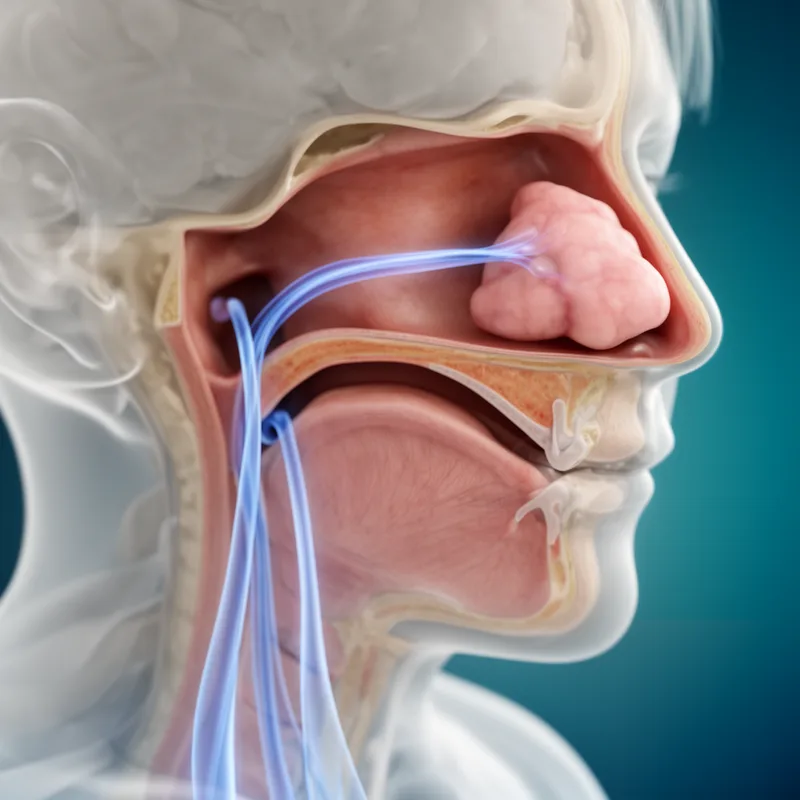
third tonsil
- noun
- /θɜrd ˈtɒnsəl/
- Specialized
- In some children, the third tonsil can become enlarged and block nasal airflow.
Examples
-
The surgeon examined the third tonsil for signs of infection.
-
Chronic inflammation of the third tonsil may cause breathing difficulties.
-
The third tonsil is important.
-
Many people are unaware of their third tonsil.
-
Chronic inflammation of the third tonsil may cause breathing difficulties.
-
In some children, the third tonsil can become enlarged and block nasal airflow.
-
The surgeon examined the third tonsil for signs of infection.
Synonyms

 5
7.4
5
7.4

A mass of soft tissue behind the nose that can swell in children

A small patch of tissue at the back of the nose that helps fight infections

A mass of soft tissue at the back of the nose above the throat that helps fight infection

A mass of soft tissue at the back of the nose that can block breathing

A mass of soft tissue at the back of the nose that can block breathing
Surface Forms
Morphology
The phrase is a direct composition of 'third' (an ordinal) and 'tonsil' (a lymphatic tissue), so a learner who knows both words can infer it refers to the third of the tonsils (i.e., another specific tonsil such as the pharyngeal/adenoid). The meaning does not rely on idiomatic or metaphorical extension and follows ordinary English noun modification patterns, making it immediately comprehensible.
Etymology
Third tonsil is a simple name for the hidden tonsil at the back of the nose, another name for the 'adenoids'. Think of the two tonsils you can see in the mouth and a third one behind the nose that can swell and block breathing, and you have the memory hook for why third tonsil means this piece of tissue that can cause breathing problems.