
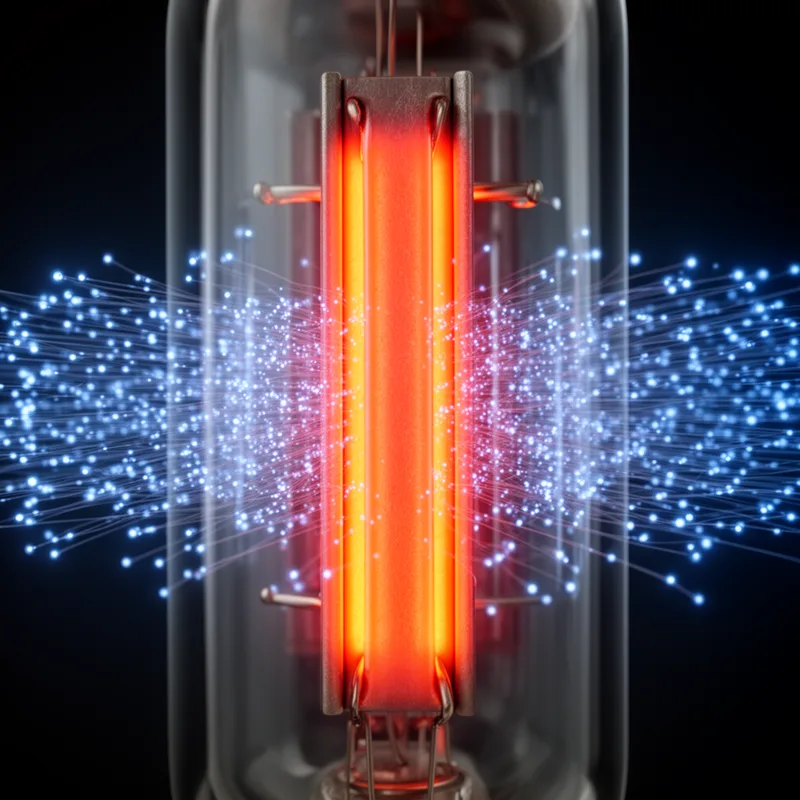
thermionic emission
- noun
- /ˌθɜrmiˈɑnɪk ɪˈmɪʃən/
- Specialized
- During the experiment, they observed significant thermionic emission when the metal was heated to high temperatures.
Examples
-
We just need to test if the only thing missing here is the thermionic emission to make the display work, so the DC test is fine.
Blog text (28) -
This would put 100 mA through the filament and should cause the thermionic emissions we need.
Blog text (28) -
It seems the radio has a dead heater driver for the cathode filament, which should be producing the thermionic emission of electrons needed to cause the fluorescent tracks to fluoresce.
Blog text (28) -
The scientists studied the process of thermionic emission to enhance the efficiency of vacuum tubes.
-
Understanding thermionic emission is crucial for developing better electronic devices that rely on electron flow.
Synonyms

The release of electrons from a material because it is very hot
Surface Forms
Morphology
Both constituents are compositional: 'thermionic' denotes heat-related (electron/ion) effects and 'emission' means release, so together they straightforwardly indicate the release of electrons from a heated material. This follows normal English technical compounding and would be understandable to a learner who already knows the constituent meanings.
Etymology
The term thermionic emission comes from parts like thermo, meaning 'heat', and emission, meaning 'sending out'. Picture a hot metal that makes tiny charged particles called electrons jump away, so the phrase refers to 'the release of electrons from a heated material'.

