
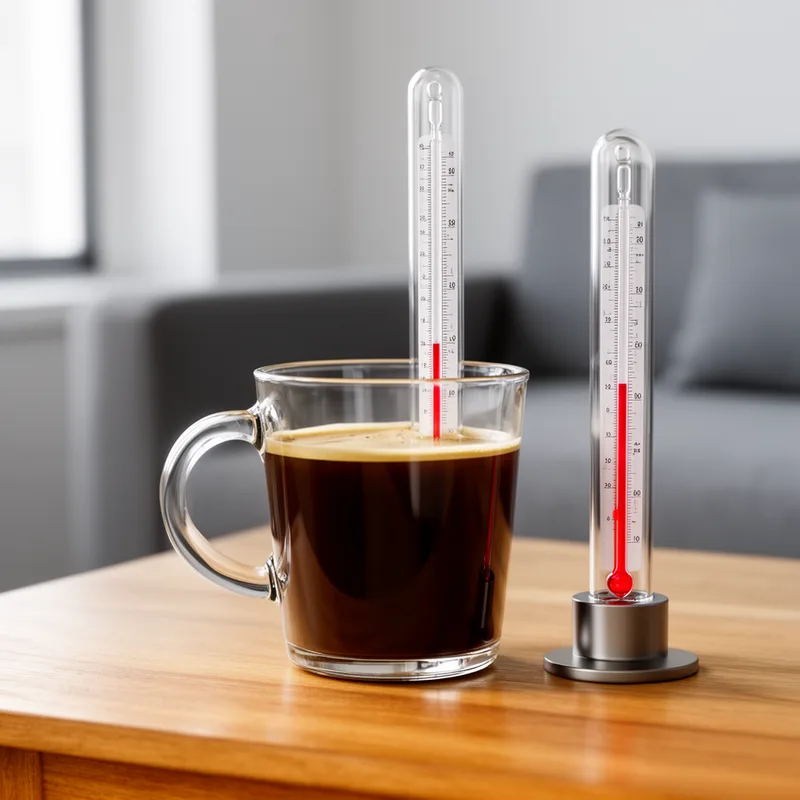
thermal equilibrium


 1
6.4
1
6.4
- noun
- /ˈθɜrməl ˌiːkwɪˈlɪbriəm/
- Specialized
- The real physics is quite subtle because the detector is in IR thermal equilibrium with the gas column.
Loading YouTube…
Watch on YouTubeOf course, that's a state of thermal equilibrium.
- Of course, that's a state of thermal equilibrium.
Examples
-
The two objects were placed in the same environment until they reached thermal equilibrium and had equal temperatures.
-
The universe was sufficiently small to have achieved thermal equilibrium at very early times, and it maintained this as it inflated.
Academic text (2002) -
But is this hot volume in thermal equilibrium?
Academic text (2003) -
It's rather hard to bring radiation in the room into thermal equilibrium with the air.
-
Experiments must determine to what extent the system is in thermal equilibrium.
Academic text (2003) -
OK, so let's calculate how fast particles move at thermal equilibrium in room temperature.
-
Notice that before inflating, the tiny initial universe could have achieved thermal equilibrium.
Academic text (2002) -
At thermal equilibrium, increasing the strength of the magnetic field induces abrupt jumps of the Fermi level at particular field values.
Academic text (1994) -
Even though there is a non-uniform temperature distribution, the column of gas will still be in thermal equilibrium because the non-uniformity simply arises due to the decreasing density of the atmosphere with altitude.
Blog text (18) -
As you say, in a perfectly transparent atmosphere with no lateral heat transport, there would be no surface warming caused by the atmosphere, because the atmosphere would be in quasi-static thermal equilibrium with the surface and would not lose energy at all on the outside (air-vacuum) interface.
Blog text (18)
How Thermalized
- Specialized
1
6.4

- Specialized
Surface Forms
Morphology
The term is directly compositional: 'thermal' (relating to heat) modifies 'equilibrium' (a stable state), so a learner who knows both words can infer a stable state with respect to temperature/no heat flow. Although somewhat technical, the adjective+noun composition and the concept have clear parallels in other languages, making the meaning predictable for a B1 learner who knows the constituents.
Etymology
Thermal equilibrium with thermal meaning heat and equilibrium meaning balance paints a simple picture: two things reach the same temperature so no heat moves between them. That's why thermal equilibrium means 'all parts have the same temperature and no heat flows'.