
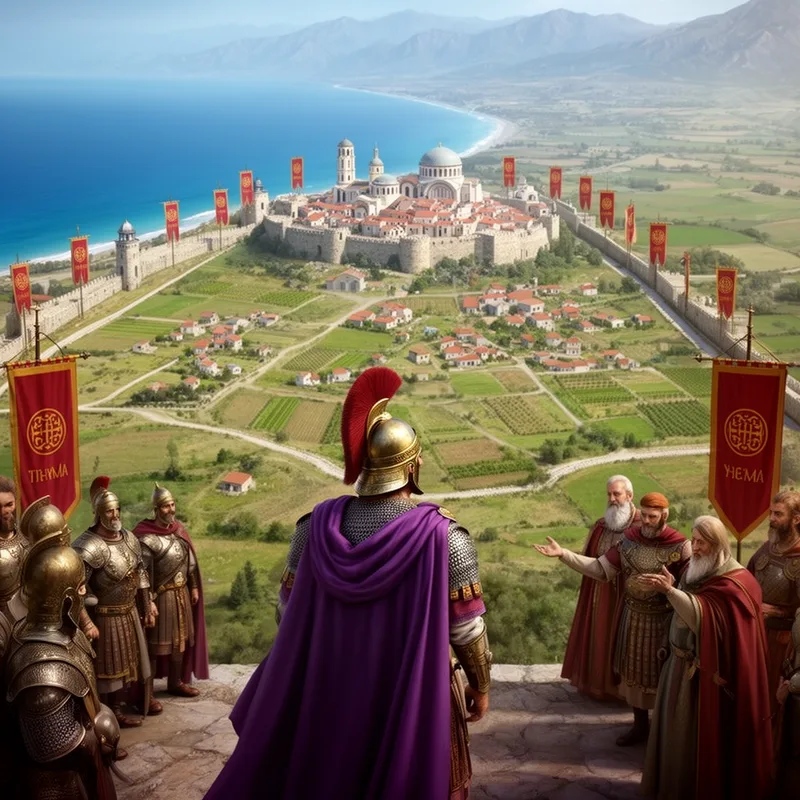
thema
- noun
- /ˈθiːmə/
- Archaic
- Each thema was governed by a strategos who managed both civil and military affairs.
Examples
-
The thema system was crucial for organizing the Byzantine Empire's military and administration.
-
Historians study the thema structure to understand how the empire maintained control over its territories.
-
The thema of Thrace was strategically important.
-
In the Byzantine Empire, a thema was often governed by a general.
-
The thema of Asia Minor was essential for the Byzantine military strategy.
-
A thema in the Byzantine Empire often included both civilian and military responsibilities.
-
The administrative duties of each thema were overseen by appointed military officials.
Synonyms
 209
3.0
209
3.0

A large area of a country with its own local government
 2
8.2
2
8.2
A part of a country like a state or province that a local leader runs
 1
9.9
1
9.9
A county ruled by a count in the past

An old province or local government area like in ancient Greece

An area that a police station covers
Surface Forms
Etymology
Thema was also used in the Byzantine Empire to mean a district or province 'set' up for soldiers and governors, so these areas mixed military and civil rule. That's why historians still call those provinces 'themes' when they talk about the empire.