

tetrode
- noun
- /ˈtɛtroʊd/
- Archaic
- The engineer designed a new circuit using a tetrode to improve signal amplification.
Examples
-
In her lab, she tested several tetrodes to determine which provided the best switching capabilities.
-
A thousand watts are generated by a pair of big Eimac tetrodes in the final amplifier.
Fiction book (1995) -
A tetrode can effectively enhance the performance of various electronic devices.
Synonyms

 65
8.8
65
8.8

An old glass part used in radios and sound equipment to make sound louder
 5
5.3
5
5.3
A glass or metal tube with empty space inside that controls electricity

A glass or metal device that controls electric current in old radios and televisions
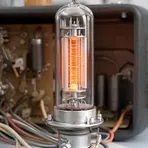
A glass or metal device that controls the flow of electricity in old radios and machines

A glass or metal tube that uses heat to make electricity flow without air
Surface Forms
Morphology
tetrode = tetr + ode
The numeric combining form 'tetr-' (four) is visible, but '-ode' is a bound technical element (not a standalone morpheme with the same sense), so the numeral is clear while the device-type element is only partially transparent to learners.
Etymology
Tetrode comes from the Greek prefix tetra- 'four' and the ending -ode, seen in words like diode and triode. So a tetrode is literally a 'four-part' tube, a vacuum tube with four electrodes used to make electrical signals stronger or to switch them.