

taste cell
- noun
- /teɪst sɛl/
- Specialized
- The human tongue holds thousands of taste cells that help us enjoy various flavors.
Loading YouTube…
Watch on YouTubeAnd when they do so, they signal through the cell, through the rest of the taste cell.
- And when they do so, they signal through the cell, through the rest of the taste cell.
Examples
-
Each taste cell in the tongue responds to specific types of chemical molecules found in food.
-
A single taste cell can detect various flavors.
-
Damage to a taste cell can result in the loss of taste sensation in that area.
-
Scientists are studying how taste cells regenerate after injury.
-
The human tongue contains many taste cells.
-
Each taste cell has specific receptors that respond to different flavors in our food.
-
Scientists discovered that taste cells on the tongue play a crucial role in sensing sweetness.
Synonyms


 1
7.5
1
7.5
A cell that senses chemicals like those for taste or smell
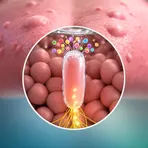
A cell in a taste bud that senses chemicals mixed in saliva and sends signals to nerves
How Specialized
- Specialized

- Specialized
Surface Forms
Morphology
The compound meaning is directly derivable from 'taste' (the sensory ability) + 'cell' (a microscopic living unit): a cell related to taste. This follows a regular noun–noun composition pattern (modifier specifying function) that is cross-linguistically common, so a B1 learner who knows both constituents will readily infer the MWE's meaning.
Etymology
Taste cell comes from the simple idea of a tiny cell that does taste: it sits in a taste bud, senses chemicals in food, and sends a message to the nerves. So taste cell means 'a cell that detects taste'.