
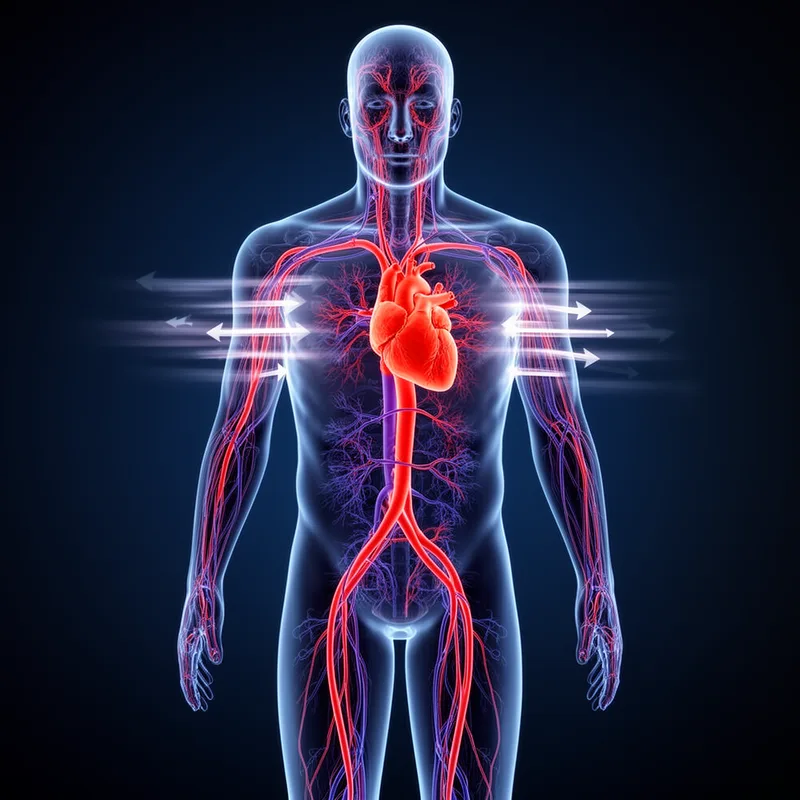
systemic circulation
- noun
- /sɪˈstɛmɪk ˌsɜrkjʊˈleɪʃən/
- Specialized
- During physical exercise, the systemic circulation increases blood flow to the muscles, providing them with more oxygen.
Examples
-
In the presence of exertional muscle injury in Type II muscle fibers, myoglobin is released from muscle, subsequently entering the systemic circulation (Dhawan et al., 2005).
Academic text (2005) -
There is severe arterial underfilling in the systemic circulation due to pronounced arterial vasodilatation in the splanchnic circulation, which is related to the presence of portal hypertension.
Academic text (2003) -
Although the systemic circulation was intact, the brain showed no objective evidence of function.
Academic text (2018) -
They're reabsorbing this fluid back into the systemic circulation, leaving behind what?
-
The principal abnormality in the systemic circulation is low arterial pressure due to greatly reduced total systemic vascular resistance.
Academic text (2003) -
Then again, congestive right-sided failure impedes blood originating from the body to the right ventricle, which affects the systemic circulation.
Blog text (11) -
In the systolic (or pumping) phase of the cardiac cycle, the left ventricle pushes out about 60% or more of the blood it holds into the systemic circulation.
Academic text (2011) -
The heart pumps oxygenated blood into the systemic circulation, delivering nutrients to the body's tissues.
-
Damage to the heart can affect the efficiency of systemic circulation, causing symptoms like fatigue and shortness of breath.
Antonyms
- Specialized
The flow of blood from the heart to the lungs and back where it gets oxygen
Surface Forms
Morphology
The phrase combines 'systemic' (pertaining to the entire system) with 'circulation' (movement of blood), so a learner who knows both words can infer it refers to blood flow through the whole body. Although detailed medical distinctions (e.g. exclusion of the lungs or oxygenation specifics) require domain knowledge, the core meaning is compositionally transparent and cross-linguistically accessible.
Etymology
Systemic circulation gives a simple image: the heart pumps blood all around the body's systemic 'system' and the blood moves in a loop, the circulation, back to the heart. That's why it means the part of the blood flow that goes from the heart to the whole body and returns.

