

syncytial


 1
9.9
1
9.9
- adjective
- /sɪnˈsɪʃəl/
- Specialized
- A syncytial mass can form in muscle tissue when individual cells fuse together, resulting in a structure with many nuclei.
Examples
-
For samples that exhibited syncytial cytopathic effect (CPE) on cell culture, we used immunofluorescence testing with monoclonal antibodies to preliminarily identify viruses (12).
Academic text (2012) -
In some organisms, the fertilized egg develops into a syncytial structure, where multiple nuclei share a common cytoplasm.
-
The research focused on how viral infections can lead to syncytial changes in lung cells, indicating severe disease progression.
Synonyms
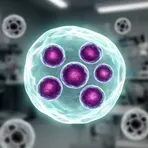
Having more than one nucleus inside a single cell

A cell that has two or more nuclei inside it

Having more than one center inside a single cell
Compounds

- Specialized
A virus that infects the breathing tubes of young children and can cause serious chest infections like pneumonia
Surface Forms
Morphology
syncytial = syncytium (opaque) = syn + cyt + ial
The adjective is a regular scientific formation from the technical noun syncytium, but the base word and its Greek components are not transparent to most learners.
Etymology
Syncytial comes from syn- meaning 'together' and -cyt- from Greek kytos meaning 'cell'. So a syncytial tissue is like many cells stuck 'together' and sharing one common space, which is why we use it for fused muscle fibers or viral cell masses.