
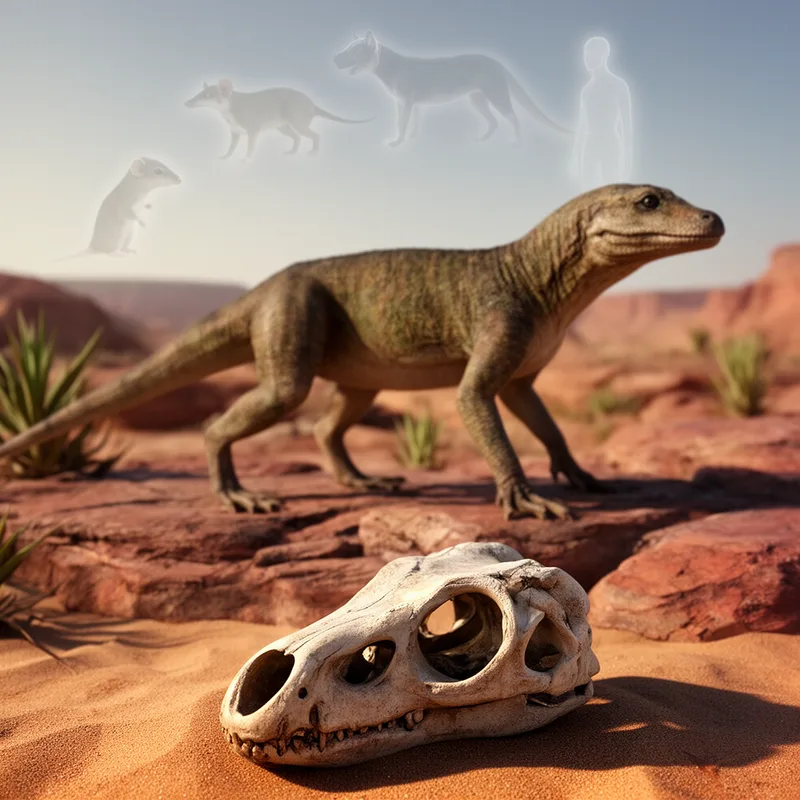
synapsid
- noun
- /sɪˈnæpsɪd/
- Specialized
- The fossil record reveals that synapsids were the ancestors of modern mammals.
- reptiles called synapsids
Examples
-
That is the one thing that that the little subtle thing, the little nuance of anatomy that defined the synapsid line as they split off from the reptiles.
-
Both mammals (synapsids) and birds, reptiles, and crocodiles (sauropsids) exhibit some form of mother-caring behavior, but amphibians do not.
Academic text (2014) -
When a group of reptiles called the synapsids branched off from the main reptile line to become the precursors of mammals, the jaw again underwent changes.
Academic text (2003) -
The postdentary bones in synapsids are the functional jaw elements; the quadrate and articular are both large, and the stapes is relatively massive, and it contacts the quadrate distally.
Academic text (2003) -
During the late Permian, several species of synapsids thrived in a variety of environments.
-
Scientists study synapsids to understand the evolutionary history of mammals.
Synonyms
An extinct reptile with one pair of holes in the skull behind the eyes that led to mammals

A group of animals like reptiles from long ago that are early ancestors of mammals
Compounds
- Specialized
An extinct reptile with one pair of holes in the skull behind the eyes that led to mammals
How Mammalian


Surface Forms
Morphology
synapsid = syn + apsid
A technical scientific coinage from Greek combining forms; the components are not productive common English morphemes and a B1 learner would not reliably infer the meaning from 'syn' + 'apsid'.
Etymology
Synapsid comes from Greek parts syn- meaning 'together', as in synchronize, and apsis meaning 'arch' or 'vault', like a church 'apse'. The name points to the single arch-like opening on each side of the skull, so synapsid helps you remember these ancient, mammal-like animals by their one side opening.