

superposition
- noun
- /ˌsuːpərpəˈzɪʃən/
- Specialized
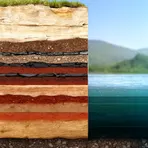
- Geologists apply the principle of superposition to determine the age of rock layers, with the oldest layers found at the bottom.
Examples
-
The superposition principle is always exactly true.
Blog text (29) -
To understand the geological timeline, one must grasp the concept of superposition, which helps reveal the order of sedimentary layers.
-
Of course, my answer is yes, it's the superposition principle.
Blog text (30) -
I guided them to the law of superposition, which states that the rock layer on the bottom is usually the oldest.
Academic text (1997) -
Moreover, compared to a QM approach using localized functions, the approach based on plane waves avoids the accuracy problem related to the basis superposition error and allows a better description of the polarization of the electronic wave functions.
Academic text (2001) -
In geology, the superposition principle states that in an undisturbed sequence, younger rocks lie above older ones.
Synonyms
 1
7.2
1
7.2

Layers that form in rock, soil, or water


 1
3.7
1
3.7
Rock or soil that forms in layers over time

A rule that in rock layers left in place the bottom layer is oldest

The lowest layer in a series of rock layers is the oldest
Compounds

- Specialized
Movement at any point is the sum of the movements caused by each wave
- Specialized
A rule that in rock layers left in place the bottom layer is oldest

- Specialized
A law that when waves overlap their effects add up at each point
Surface Forms
Morphology
Etymology
Superposition comes from super- ('above') and position ('place'), so it literally means 'placed above'. In geology this helps you remember that layers are read by what is 'above' and what is below, with newer layers on top and older ones at the bottom.