
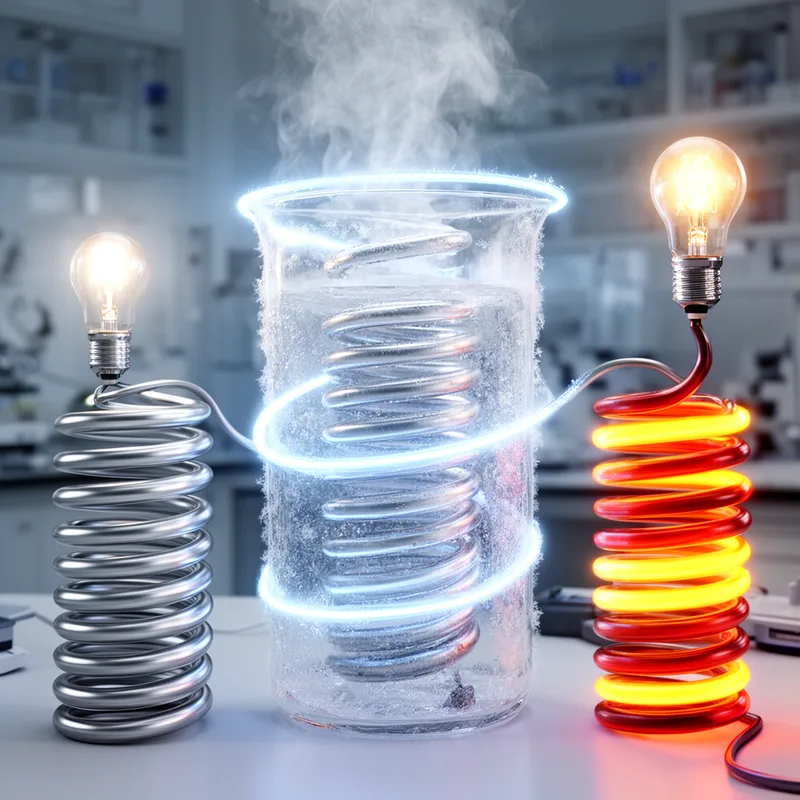
superconducting
- adjective
- /ˌsuːpərkənˈdʌktɪŋ/
- Specialized
- When cooled to very low temperatures, superconducting materials allow electricity to flow without any resistance.
Loading YouTube…
Watch on YouTubeHowever, they've kept up with superconducting qubits well.
- However, they've kept up with superconducting qubits well.
- So this does seem like one of those spaces where the the scale of superconducting optoelectronics, the way that.
- There are small superconducting circuits and trapped ions and defects in crystals and photons in a medium, and so on.
- And we've seen all sorts of players, you know, from neutral atoms, trapped ions, superconducting metal photons in at different frequencies.
Examples
-
For now, there are two leading approaches, trapped ions and superconducting qubits.
-
So we've seen superconductivity in action here with a little pack of superconducting material which expels the magnetic field through the Meissner effect.
-
This was part of a a superconducting RF filter.
-
In reality, this means that the main superconducting coil in Mris does not consume any power directly.
-
We have created some unconventional superconducting transmission cable like this one just South of Seoul in South Korea.
-
IBM uses superconducting circuits as cubits that are the basic units of computation.
-
These include using superconducting electronic circuits, trapping ionized atoms, or squeezing light.
-
Researchers are studying superconducting wires to improve the efficiency of power transmission in electric grids.
-
The development of superconducting magnets has revolutionized technologies such as MRI machines by enabling stronger magnetic fields.
Synonyms
 1
8.0
1
8.0

Letting electricity flow without losing energy, usually at very low temperatures
Antonyms
Compounds
- Specialized
1
9.9
Large machine that speeds tiny particles to high energy for collisions while kept very cold so electricity flows without loss
How Conductive

Surface Forms
Morphology
superconducting = superconduct (semi-transparent) = super + conduct + ing
Adding -ing to superconduct is a regular and easily recognisable derivation.
Etymology
Superconducting is built from super- 'above' and conduct 'to carry', the same root you see in conductor. So, superconducting describes materials that 'carry' electricity in an above way: they can carry electric current with no resistance.