
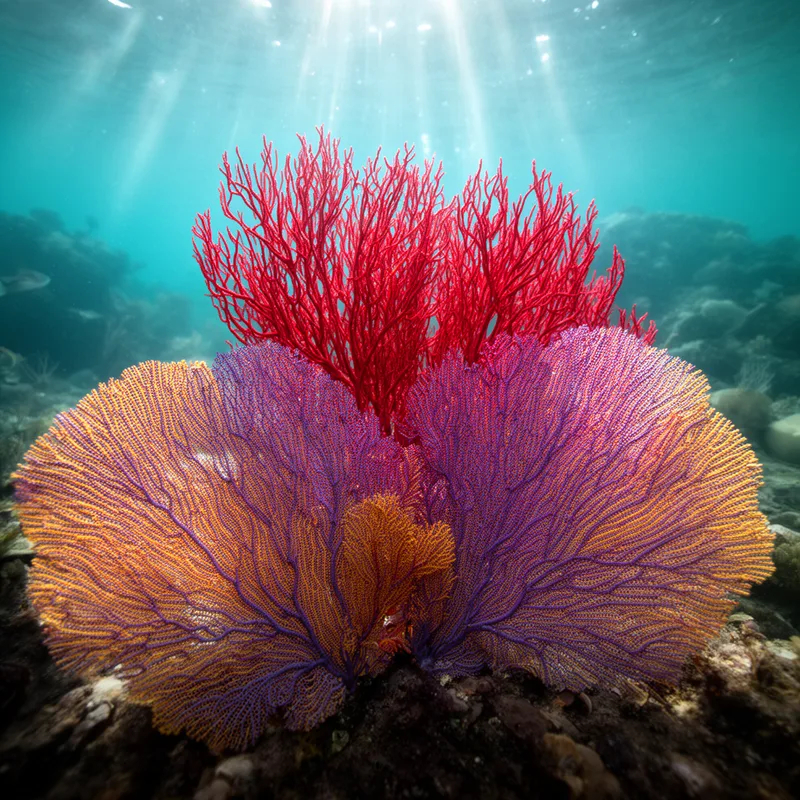
suborder Gorgoniacea
- noun
- Archaic
- The suborder Gorgoniacea includes many beautiful sea fans.
Examples
-
The distinctive shapes of suborder Gorgoniacea can be seen in many tropical reefs.
-
Scientists discovered a new species of suborder Gorgoniacea off the coast of Indonesia.
-
Many jewelry items are made from the skeletons of suborder Gorgoniacea, especially red coral.
-
Did you know that the suborder Gorgoniacea is known for its unique structures?
-
The delicate structures of suborder Gorgoniacea provide a vibrant habitat for various marine species.
-
Researchers are studying the diversity within suborder Gorgoniacea to understand coral adaptation.
-
Diving enthusiasts often admire the colorful colonies of suborder Gorgoniacea while exploring the ocean.
Synonyms

Group of soft corals in the sea like red corals and sea fans that grow in tree-like branches

An old name for a group of sea animals like sea fans and red corals
A group of soft corals like sea fans and red corals that live in warm oceans
Surface Forms
Morphology
The phrase is directly compositional: 'suborder' denotes a taxonomic rank and 'Gorgoniacea' names a group of corals, so the combined meaning is simply the taxonomic suborder called Gorgoniacea. Taxonomic naming conventions are cross-linguistically transparent, so a learner who knows both constituents would readily infer the MWE's meaning.
Etymology
Suborder Gorgoniacea comes from the old story of the 'Gorgon', a monster with snakes for hair. Early scientists thought the corals' long, branching shapes looked like a Gorgon's hair, so the name was used for sea fans, red coral and their relatives.

