

submandibular
- noun
- /ˌsʌbmænˈdɪbjələr/
- Specialized
- The three major paired salivary glands—the parotid, the sublingual, and the submandibular—produce 90% of the total salivary output.
Examples
-
On radiologic investigation, they can appear as cystic lesions in the mandible, temporal bone, neck nodes, and submandibular, parotid, and thyroid glands.
Academic text (2001) -
The submandibular gland plays an important role in producing saliva to aid in digestion.
-
A 40-year-old man presented with a gradually progressive 7 x 4-cm swelling in the right submandibular area of 9 months' duration (figure 2).
Academic text (2010) -
The surgeon carefully examined the submandibular gland for any signs of infection or swelling.
-
During the examination, the doctor noted that the submandibular region was unusually tender.
Synonyms

One of two glands beneath the lower jaw that make saliva, often at night

A gland under the lower jaw that makes saliva and releases it under the tongue, often at night

A small part under the lower jaw that makes saliva and sends it under the tongue
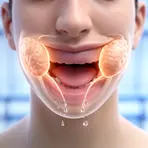
A gland under the lower jaw that makes saliva
Compounds
- Specialized
One of two glands beneath the lower jaw that make saliva, often at night
- Specialized
A gland under the lower jaw that makes saliva and releases it under the tongue, often at night
Surface Forms
Morphology
submandibular = mandibular (transparent) = sub + mandible + ar
The noun sense (the gland) is formed by adding the locative/positional prefix 'sub-' to 'mandibular', describing a gland beneath the mandible.
Etymology
A submandibular comes from sub- 'under' and mandible 'jaw', meaning 'under the jaw'. So a submandibular is the salivary gland that sits under your lower jaw.

