
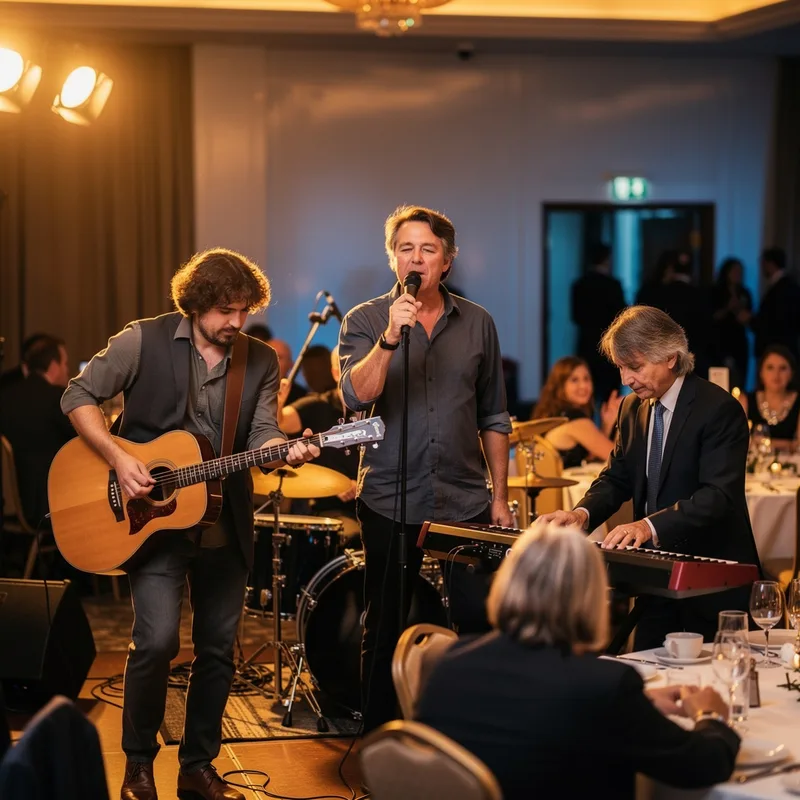
to strike up
 4
4.4
4
4.4

- phrasal verb
- /straɪk ʌp/
- As they stepped onto the wooden floor, the orchestra struck up the opening bars of a waltz.
- band struck up
- strike up a tune
- orchestra struck up
Loading YouTube…
Watch on YouTubeOut on the moon is for Lift your open head, strike up the band and make the fireflies dance till the moon sparkly.
- Out on the moon is for Lift your open head, strike up the band and make the fireflies dance till the moon sparkly.
Examples
-
The procession to the courtyard begins when a brass band strikes up, accompanied by singing and shouting.
Fiction book (1992) -
Before she could tell me anything else, the deejay struck up "Good Times."
-
Strike up the band, boys.
-
Someone would strike up a song, and the valley would ring with the sound of many voices.
-
On the sun deck above, the company band struck up "Stars and Stripes Forever."
Fiction book (1992) -
In the park kiosk, a military band struck up a march.
Fiction book (1992) -
The conductor turned away again, and the band struck up 'Good King Wenceslas.'
Fiction book (1996) -
The band strikes up the "Wedding March" as Billie and her father walk down the aisle.
Fiction book (1990) -
The Irish ballad ends, and Lawrence Welk's Champagne Orchestra strikes up a lively polka.
Fiction book (1993) -
The procession to the courtyard begins when a brass band strikes up, accompanied by singing and shouting.
Synonyms
 2
3.6
2
3.6
Make a rhythm by hitting something repeatedly, like a drum
 1
5.5
1
5.5
To begin to play music or make a sound to mark a start
 1
9.3
1
9.3
Play loud, energetic music to make people excited


 1
7.0
1
7.0
To play a strong, repeated beat by hitting an instrument like a drum

To start to play music or sing suddenly
Antonyms

- Archaic
To stop doing an activity, especially to stop playing music for good
How Quickly

Surface Forms
Morphology
strike + up
The meaning 'to begin to play music or start singing' is directly derivable from 'strike' (to produce a sound by hitting) plus the particle 'up' which commonly signals the beginning or initiation of an action. This verb+particle composition follows a standard, cross-linguistic pattern (e.g. 'start' + noun) and would be understandable to a B1 learner who knows the constituent words.
Etymology
Strike up for music comes from the picture of a band leader hitting an instrument or giving a sharp signal to start playing. That's why when a band strikes up a tune it means they 'begin' to play music.