
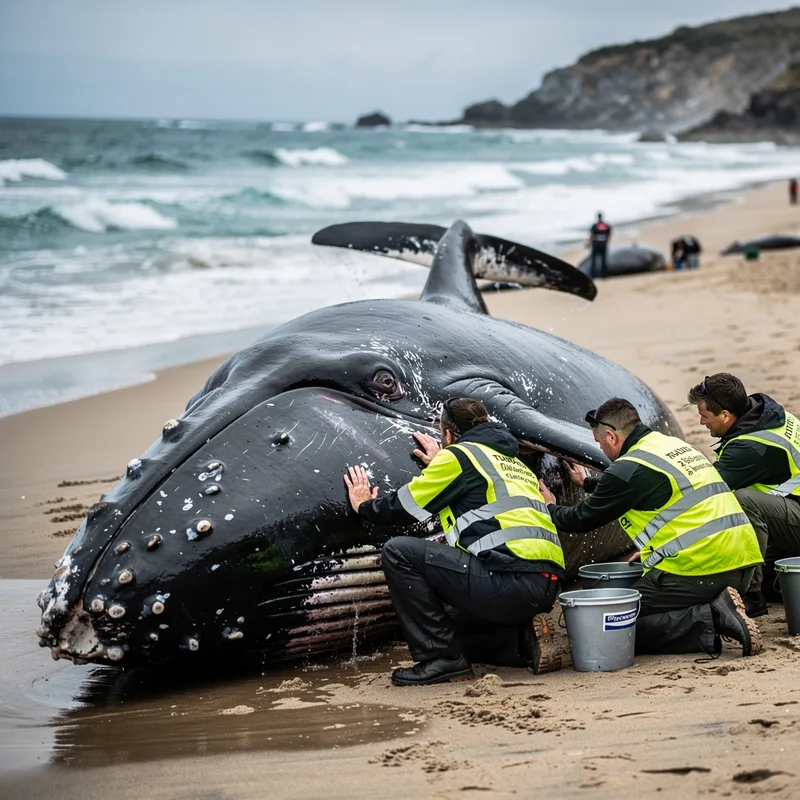
stranding
 2
5.9
2
5.9

- noun
- /ˈstrændɪŋ/
- However, live leatherback strandings are extremely rare, with the Aquarium only handling five leatherbacks on Massachusetts beaches in more than 40 years.
- strandings may result
Loading YouTube…
Watch on YouTubeScientists remain baffled at why these mass strandings occur.
- Scientists remain baffled at why these mass strandings occur.
Examples
-
Perhaps the shallow waters of upper Cook Inlet provide some degree of protection, even though strandings may result.
Academic text (2000) -
There is no evidence that strandings are the result of viral or parasitic infections.
Academic text (2000) -
Although stranding occurs fairly often, mortality associated with it seems to be low.
Academic text (2000) -
It's really only known from strandings, not from any study of live animals in the wild.
Blog text (25) -
The stranding reports are opportunistic and therefore do not necessarily represent the actual number of occurrences.
Academic text (2000) -
Most strandings are of single whales, although live groups of 10-190 individuals have been reported (Table 3).
Academic text (2000) -
The minimum total estimated fishery-related mortality is 36 seals per year based on observer data and strandings.
Academic text (2000) -
However, in a few cases, deaths have occurred, possibly from the stress of stranding in combination with such an infection (Table 3; Burek-Huntington (n13)).
Academic text (2000) -
No study on carcass recovery from strandings has ever recovered anything close to 100% of the deaths occurring in any cetacean population.
Blog text (3) -
The mass stranding of dolphins on the beach left the community shocked as many tried to rescue them.
Synonyms

Leaving someone alone on a remote island as a punishment
Antonyms


How Stranded

Surface Forms
Morphology
Etymology
Stranding comes from the old word strand, which meant 'shore' or 'beach', so imagine a whale left on the sand. That is why a stranding means being left somewhere with no way to leave.