
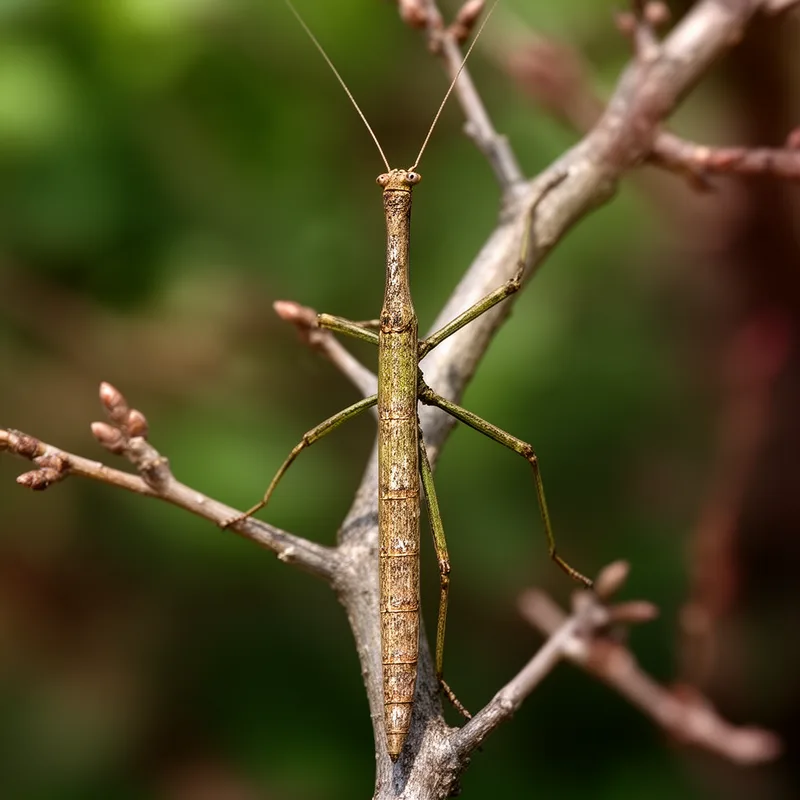
stick insect
 1
5.6
1
5.6

- noun
- /stɪk ˈɪnsekt/
- We spotted a stick insect resting on a leaf, its body shaped just like a stick.
Loading YouTube…
Watch on YouTubeSo I would I would ban stick insects as pets.
- So I would I would ban stick insects as pets.
Examples
-
This stick insect, painstakingly extruding itself from its egg, is an individual from one of the most endangered insect species on Earth.
Blog text (31) -
Upon revisiting the bush the day after, the team was astounded to find two huge stick insects quietly straddling the bush.
Blog text (31) -
The Lord Howe Island stick insect, as it's called, was declared extinct in 1960.
Blog text (31) -
A stick insect lives in a world of twigs, and its body is a precise replica of a twig.
Academic text (1995) -
This little bush, and those that no doubt preceded it, had been sustaining the only Lord Howe Island stick insects in the world for half a century.
Blog text (31) -
It turns out this little bush was feeding the entire population of Lord Howe Island stick insects on Ball's Pyramid—24 individuals in total—providing food and a soft soil surface for them to lay their eggs in.
Blog text (31) -
The stick insect camouflaged itself perfectly among the branches, resembling a twig.
-
While hiking in the rainforest, I encountered a stick insect that was nearly invisible against the tree bark.
Synonyms
 623
1.0
623
1.0
A small insect like an ant or beetle
 341
1.0
341
1.0
A small animal with a body in three parts, six legs and often wings
A long thin insect that hides on branches by looking like a stick
A long thin insect that looks like a twig
Surface Forms
Morphology
The meaning of 'stick insect' is directly derivable from combining 'stick' (a thin, rod-like object) with 'insect' (a small arthropod): it denotes an insect that resembles a stick. This noun–noun compounding pattern is a transparent, common way to name animals by appearance across many languages, so a B1 learner who knows both constituents will readily understand it.
Etymology
Stick insect comes from the insect's look: its long, thin body looks like a stick or twig, so it 'hides' by staying still on branches. That's why the name means an insect that 'looks like a stick' to avoid being seen.