
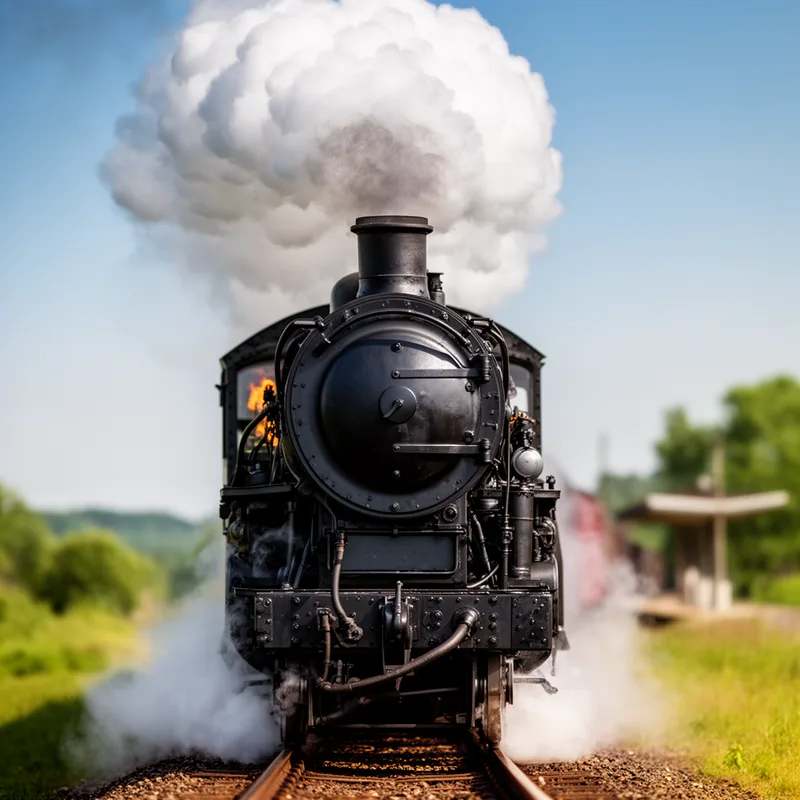
steam locomotive
 3
3.2
3
3.2

- noun
- /stiːm ˈloʊkəˌmoʊtɪv/
- Children loved watching the steam locomotive puff clouds of steam as it pulled into the station.
Examples
-
It's a Baldwin 2-8-4 S3-class steam locomotive, built in 1931 at the Baldwin Locomotive.
-
While electric and steam locomotives coexisted on America's railways in the 1920s, the two technologies resided in completely separate camps.
Academic text (2005) -
Many of these remind me of stories I heard as a kid, and of course I well remember steam locomotives.
Blog text (34) -
And I, for one, think a classic steam locomotive is a lot more interesting than a modern diesel one.
Blog text (18) -
My neighbor was an engineer on a steam locomotive and gave my cousin and me a ride on one.
Blog text (34) -
The museum is on the former site of Southern Railway's Spencer Shops, a steam locomotive servicing facility.
Blog text (6) -
I grew up near a railroad switch yard in St. Louis Park, MN, and remember the huge steam locomotives.
Blog text (34) -
However, steam-powered trains were not useful in urban centers, and many companies that operated steam locomotives failed to adapt their technology.
Academic text (2005) -
Stevenson then produced the Stevenson's Rocket, which developed the design of steam locomotives to the point where railways could be built for general transportation.
Blog text (4) -
Well, they’re more or less all gone now—the big steam locomotives, with their glitter, their power.
Fiction book (1999)
Synonyms
 89
3.5
89
3.5
A vehicle that pulls train cars on railway tracks
 37
4.6
37
4.6
A train engine that pulls rail cars
 1
5.0
1
5.0
A steam train that carries its own fuel and water without another car behind it

A steam engine that carries its own fuel and water so it needs no separate car
A large machine on wheels that pulls a train on tracks

A machine on train tracks that pulls or pushes trains
Surface Forms
Morphology
The meaning is directly compositional: 'steam' specifies the power source and 'locomotive' names the railway vehicle, so a learner who knows both words can infer a locomotive powered by steam. This compound pattern is cross-linguistically common (e.g. French 'locomotive à vapeur', Spanish 'locomotora de vapor'), reinforcing its predictability for B1 learners.
Etymology
The name steam locomotive comes from the image of a moving kettle: boiling water makes steam that pushes parts inside the locomotive to turn the wheels. So, steam locomotive means 'a train engine powered by steam'.