

stator
 1
8.5
1
8.5

- noun
- /ˈsteɪtər/
- Specialized
- The magnetic field is produced using electromagnets carefully positioned at different locations in the stator.
- rotor and stator
- stator vane
- stator winding
Examples
-
Many EVs run on induction motors, which have two main parts, a stator and a rotor.
-
Energizing the stator causes the rotor to oscillate between the two positions.
Academic text (1995) -
The 11000 Series is made with few parts and only one stator phase.
Academic text (1995) -
The equal wall stator reduces starting torque and is said to allow twice the pressure.
Academic text (1996) -
For a simple generator, the stator may have two field magnets on opposite sides.
Academic text (2008) -
The generator itself has two basic parts: the stator, which is stationary, and the rotor, which rotates.
Academic text (2008) -
To minimize the rotor and stator losses that result from stator teeth, engineers used an air-gap wound stator.
Academic text (1995) -
The rotor rotates as its currents interact with the stator's revolving magnetic field.
Academic text (1995) -
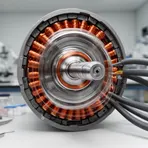
In a typical motor, the stator is the stationary part that surrounds the rotating rotor.
-
The stator consists of coils that create a magnetic field when electricity flows through them.
Antonyms
- Specialized
2
5.2
A part inside a motor that turns inside the fixed outer part to make or use electricity
Compounds

- Specialized
Fixed wire loops inside a motor that make a magnetic field when electric current flows
Surface Forms
Etymology
Stator comes from the Latin root stare, which means 'to stand' and is like the English word 'stand' or 'stationary'. A stator is the part of a motor that stays still while the rotor moves, so the name means the 'standing' or fixed part.