
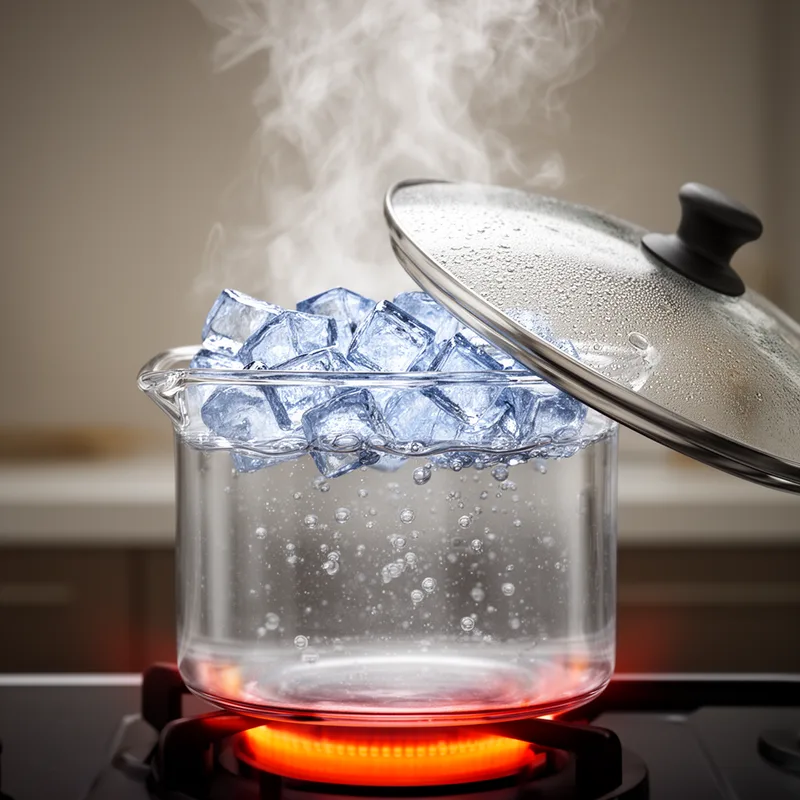
state change
- noun
- /steɪt ʧeɪndʒ/
- Specialized
- During a state change, substances like carbon dioxide can transition from solid dry ice directly to gas.
Examples
-
The state change of ice to liquid water happens when the temperature rises above 0 degrees Celsius.
-
The state change is restricted to go from the current state only to an adjacent state; this improves the response to jitter.
Academic text (1996) -
Mathematics is sometimes confusing with countable state change, as we've seen.
-
Moreover, nature is not universally resilient; in some cases, ecosystems can undergo a state change from which recovery is unlikely on timescales relevant to humans.
Academic text (2012) -
Water's state change from a liquid to a gas occurs when it is heated to the boiling point.
Synonyms

 4
3.4
4
3.4

A change where something changes state or appearance but stays the same substance
 1
5.5
1
5.5
A change when a material goes from one state to another without a chemical change, like ice melting
 1
4.1
1
4.1
A material that moves from solid to liquid or gas without making a new substance

A process when something becomes a different form or condition
Surface Forms
Morphology
The phrase 'state change' simply combines 'state' (a physical form) with 'change' (the act of becoming different) to denote a change from one physical state to another, so a B1 learner who knows both words can infer this meaning. Although common in scientific contexts, the composition follows regular English compounding patterns and has direct equivalents in many other languages, supporting full transparency.
Etymology
The phrase state change comes from a simple image of something changing its state, like water turning from 'liquid' to 'gas' when it boils or to 'solid' when it freezes. Because change means moving from one condition to another, the phrase means the process when a material moves into a different 'state'.