

to stand up
 27
1.0
27
1.0

- phrasal verb
- /stænd ʌp/
- Like if I put, if I stand this up, oh, I can even balance it.
Loading YouTube…
Watch on YouTubeHow do you get that to stand up and stay there?
- How do you get that to stand up and stay there?
Examples
-
Do I flatten it or find a way to make the model stand up on the uneven surface?
Blog text (25) -
How do you get that to stand up and stay there?
-
And if you stood it up just like this, you could stand it up on a stake off the ground.
-
I stuffed the onesie so it would stand up on its own.
Blog text (20) -
Camping lamplights are convenient as they can stand up by themselves and shed a large circle of light.
Blog text (3) -
Trevor stands up and looks around the mazelike structure of cubicles as far as he can see.
Fiction book (2002) -
He carefully adjusted the leaning tower to stand up straight against the wall.
-
To make it easier to paint, she decided to stand up the canvas on an easel.
-
He wanted the trophy to stand up proudly on the mantlepiece for everyone to see.
Synonyms
 ∞
1.0
∞
1.0
To be or put something in an upright position


 1
3.8
1
3.8
To make something stand up again after it falls
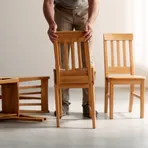
To put something so it stands up instead of lying down
Antonyms

How Upright

Surface Forms
Morphology
There is a clear link between 'stand' (to endure or resist) and the MWE meaning, while the particle 'up' functions as an intensifier that yields a confrontational sense; however the precise sense 'confront/refuse to back down' is not entirely predictable from the parts for an unexposed B1 learner. This pattern is partially compositional but relies on phrasal-verb semantics that vary cross-linguistically, so prior exposure usually helps.
Etymology
Stand up for something or someone can come from the idea of making an object stand on its end; you set it so it will stand and point up. That's why it also means 'to put something in an upright position'.