

to stalk its prey
 6
6.6
6
6.6

- phrasal verb
- The lion silently stalks its prey, waiting for the perfect moment to pounce.
- predator stalking unsuspecting prey
- cat stalking its prey
- hunter stalking prey
Examples
-
I've crawled across grass and tide pools and steaming sands while stalking prey.
Fiction book (1994) -
A juvenile will shop carefully, waiting patiently on a perch or actively stalking prey.
Academic text (1990) -
He walks around the ring, stalking his prey.
Blog text (19) -
With goosebumps, she got up and, like a cat stalking its prey, slowly approached the window.
Fiction book (1996) -
"They act like a pack of wolves stalking their prey, creating havoc on the streets," Zine said at the meeting.
Academic text (2013) -
He just stalks his prey, flitting in and out of their peripheral vision.
Blog text (14) -
A silent hunter, the great white shark stalks its prey with near invisibility, its attack both unstoppable and fatal.
-
In water, that's possible, I grant you, but a land-based creature, no matter how cunning, would be sighted either feeding or stalking its prey.
-
I meticulously inspected every nook and cranny of that study, hunting for clues, much like a panther stalks its prey.
-
While harmless to nonhost insects, the wasp stalks its leafroller prey with the agility of a big-cat predator.
Academic text (2004)
Synonyms
 ∞
3.5
∞
3.5
To try to get something you want, like a job or a goal
 322
1.0
322
1.0
To chase someone or something without stopping to catch them
 101
4.5
101
4.5
To move quietly toward someone or something without being noticed
 41
6.0
41
6.0
To move quietly and carefully while looking for animals to catch
 35
5.3
35
5.3
To move quietly around a place looking for something
 14
6.3
14
6.3
To move around while looking for something to catch or get


 1
9.8
1
9.8
To move quietly and try to catch an animal by surprise
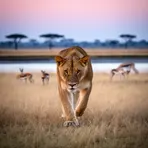
To look for animals to hunt and eat
Antonyms


How Stealthy
6
6.6
 50
2.5
50
2.5
Surface Forms
Morphology
The meaning is directly and compositionally derived from the constituents: 'stalk' (to move silently/pursue) + 'its prey' (the animal being hunted), so the phrase simply describes quietly pursuing an animal. This is a straightforward, cross-linguistically common predator–prey construction and a B1 learner who knows the component words will readily understand it.
Etymology
The phrase stalk its prey comes from the image of a hunting animal moving very quietly toward the animal it will catch: stalk means to move slowly and quietly and prey is the animal being hunted. So, stalk its prey means 'to approach or follow quietly to catch by surprise'.