
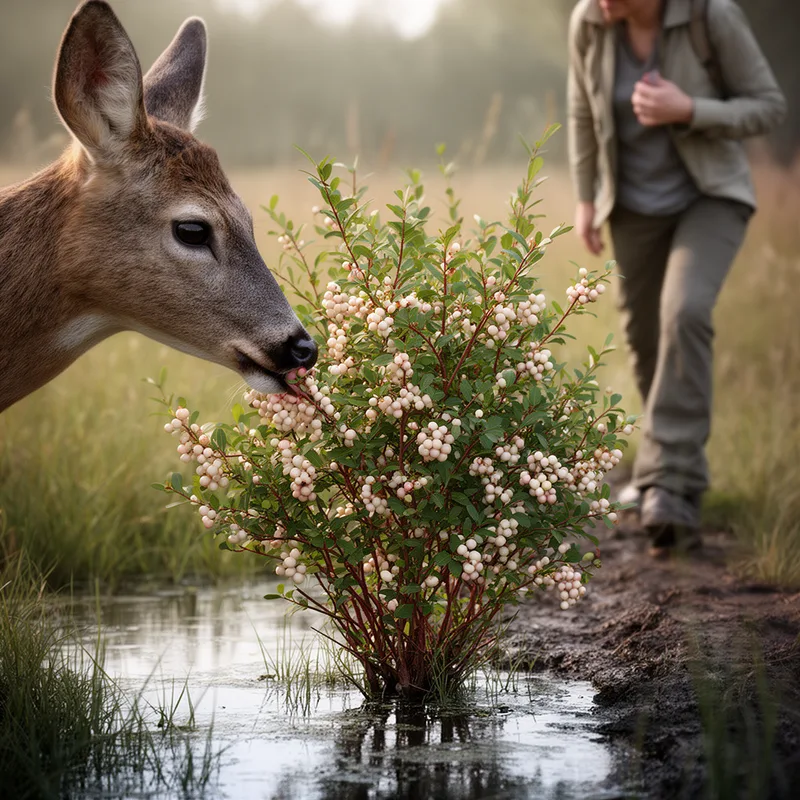
squaw huckleberry
- noun
- /ˈskwɔː ˈhʌkəlˌbɛri/
- NSFW
- Deer often eat the fruit of the squaw huckleberry, even though humans usually avoid it.
Examples
-
Many animals, including deer, eat squaw huckleberries.
-
In early summer, the squaw huckleberry produces clusters of pale berries.
-
The marsh was filled with squaw huckleberry shrubs and other wild plants.
-
The squaw huckleberry grows in wetland areas.
-
Deer often eat the fruit of the squaw huckleberry, even though humans usually avoid it.
-
In early summer, the squaw huckleberry produces clusters of pale berries.
-
The marsh was filled with squaw huckleberry shrubs and other wild plants.
Synonyms

A small branching bush that grows in wet places with greenish or yellow berries people rarely eat
A small shrub in wet areas with pale yellow berries that deer eat
Surface Forms
Morphology
squaw + huckleberry
The head noun 'huckleberry' makes it clear this is a kind of berry/shrub, and the modifier 'squaw' would signal an association or specific type, so a learner who knows both words can infer it names a particular huckleberry. However, the precise botanical properties (marshy habitat, unpalatability to humans, eaten by deer) and the cultural/pejorative status or rarity of 'squaw' are not predictable from the constituents, so the meaning is only partially transparent.
Etymology
Squaw huckleberry probably comes from early settlers who saw Native American women picking the pale, small berries in marshes. The word squaw was once used for a Native American woman but is now considered offensive, and huckleberry means 'a small wild berry', so the name points to the plant and the people who gathered it.

