

Vaccinium stamineum
- noun
- Specialized
- Though humans rarely eat its fruit, Vaccinium stamineum is an important food source for wildlife.
Examples
-
The marshy area was thick with Vaccinium stamineum, its berries attracting grazing deer.
-
Botanists surveyed the growth of Vaccinium stamineum to understand its role in the wetland ecosystem.
-
The Vaccinium stamineum thrives in wetland areas.
-
Have you seen a Vaccinium stamineum in the marsh?
-
The marshy area was thick with Vaccinium stamineum, its berries providing a vital food source for deer.
-
Botanists surveyed the growth of Vaccinium stamineum to explore its contribution to the wetland habitat.
-
Although Vaccinium stamineum produces berries that humans find unpalatable, they are enjoyed by various wildlife.
Synonyms

A small marsh bush with pale berries that deer eat and people avoid
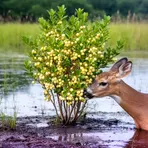
A small shrub in wet areas with pale yellow berries that deer eat
Surface Forms
Morphology
Vaccinium + stamineum
This is a Latin binomial (scientific) name rather than a compositional English phrase: the second element 'stamineum' is not a standard English word and is absent from the dictionary provided. Even if a learner knows 'Vaccinium' as a genus, taxonomic epithets are arbitrary labels and do not transparently convey the detailed descriptive meaning given, so a B1 learner would not be able to derive the MWE's meaning from its parts.
Etymology
Vaccinium stamineum comes from old Latin words: Vaccinium meant 'berry' and stamineum comes from 'stamen', the thin part of a flower that holds pollen. So the name gives a simple picture of a small berry shrub with noticeable flower parts, which fits this marsh plant whose greenish berries deer eat.

