
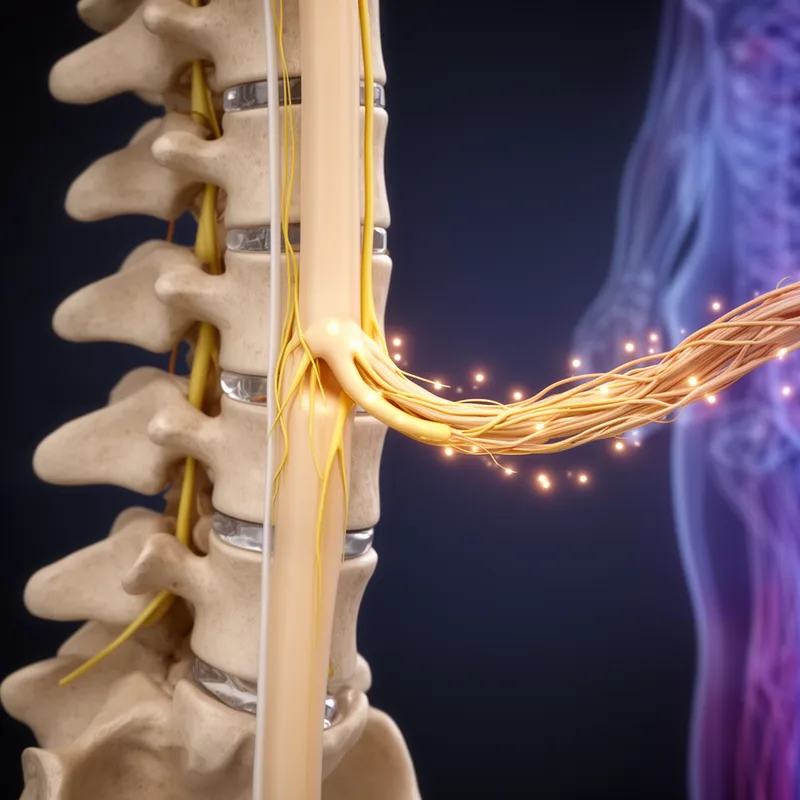
spinal nerve root
- noun
- /ˈspaɪnəl nɜrv ruːt/
- Specialized
- Compression of the spinal nerve root can result in weakness and numbness in the affected area.
- pressure on the spinal nerve root
Examples
-
The resulting impingement or pressure on the spinal nerve roots or mechanical instability results in pain, abnormal motion, or deformities (Chapman, 2001).
Academic text (2005) -
This is done to remove the portion of the disc (nucleus pulposus) that has herniated through the annulus and is causing pressure on the spinal nerve root.
Academic text (2005) -
Rupture of the annulus fibrosis and herniation of the nucleus pulposus are also results of spine conditions and causes of pressure on the spinal nerve roots.
Academic text (2005) -
The doctor explained how the injury was affecting the spinal nerve root, leading to pain in his leg.
-
Doctors often perform surgery to relieve pressure on the spinal nerve root to alleviate symptoms.
Synonyms

Groups of nerve fibers that come out of the spinal cord on each side
Surface Forms
Morphology
Each constituent is semantically transparent: 'spinal' relates to the spine/spinal cord, 'nerve' is a bundle carrying impulses, and 'root' denotes a base or origin. A B1 learner who knows these senses can readily infer that a 'spinal nerve root' is the base/origin point where a nerve emerges from the spinal cord; this composition is cross-linguistically regular and follows ordinary English compounding patterns.
Etymology
Spinal nerve root paints a simple picture: small nerve fibres come out of the spinal area like plant roots and join to form a single nerve. So the name shows the place where a nerve 'starts' and 'carries messages' to and from the body.

