
speech spectrum
- noun
- /spiːtʃ ˈspɛktrəm/
- Specialized
- Researchers often study the speech spectrum to improve hearing aids and enhance sound quality.
- aided speech spectrum
- amplified speech spectrum
- long-term speech spectrum
Examples
-
Theoretically, the ideal amplification system would contain a sufficient number of frequency bands or channels, each acting independently, to accommodate the variations in dynamic range that exist at frequencies within the speech spectrum.
Academic text (1993) -
The long-term speech spectrum was measured using a signal analyzer for the monosyllabic word lists presented at 70 and 85 dB SPL.
Academic text (1993) -
Real-ear measures were performed to ensure that participants had access to the average speech spectrum.
Academic text (2012) -
The upper right panel shows the aided speech spectrum, and the bottom right panel shows the relative gain for both the two- and three-channel systems.
Academic text (1993) -
Although backward speech and speech-spectrum noise certainly are sufficient for many purposes, rotated speech appears to be more similar to normal speech than they are.
Academic text (2012) -
The derivation involves data concerning the long-term average speech spectrum (LTASS).
Academic text (1996) -
Assuming that there should be general correspondence between the comfort loudness level and the preferred amplified speech spectrum, the discrepancy between these values for our subjects is of interest.
Academic text (1993) -
The preferred amplified speech spectrum values for both subjects, shown in the upper right panels of Figure 4 and Figure 5, are slightly lower than the comfort loudness levels measured with the LGOB procedure.
Academic text (1993) -
Interestingly, despite large differences in audiometric thresholds, the comfort loudness levels as well as the preferred amplified speech spectrum for both subjects are similar.
Academic text (1993) -
The engineer analyzed the speech spectrum to determine the frequency range of the human voice.
Synonyms

The range of high and low sounds a source makes, like a voice or instrument

The loudness of the high and low parts of a sound, for example a violin or flute
Surface Forms
Morphology
The compound is compositional: 'speech' identifies the domain (human voice/utterance) and 'spectrum' denotes a range or distribution, so a learner who knows both words can infer it refers to the range (e.g., frequencies) associated with speech. Although the term is somewhat technical, its meaning follows a straightforward modifier+head pattern and is therefore predictable to a B1 learner familiar with both constituents.
Etymology
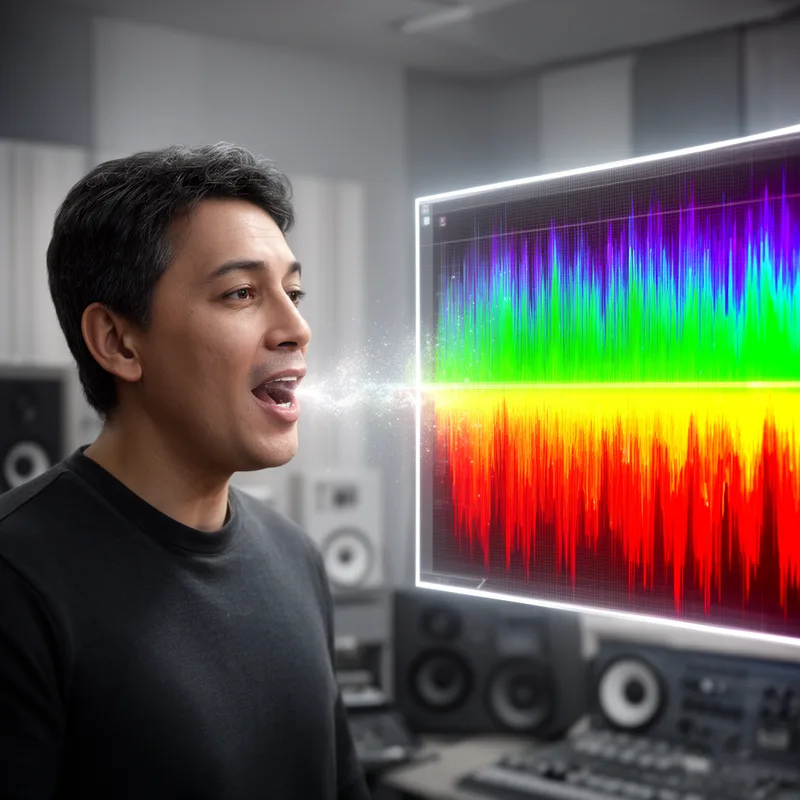
The noun speech spectrum comes from the idea of making a picture of voice sounds that looks like a band of colors: speech is the voice and spectrum used to mean a range of colors, so people used the word for sound too. So the speech spectrum is the 'range' of low to high sounds in a voice, shown in that picture.

