
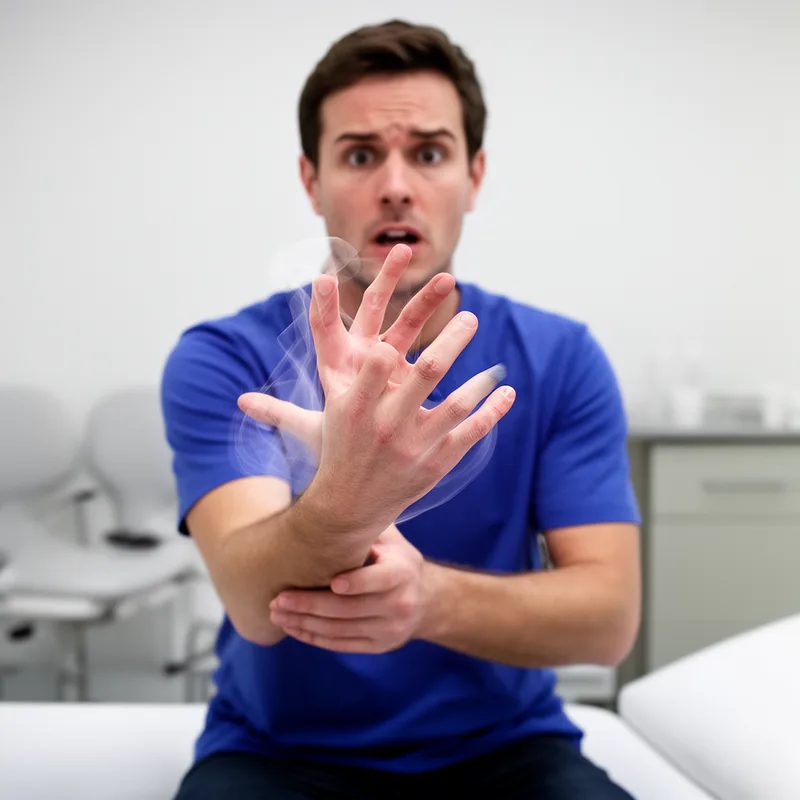
spastic gesture
- noun
- /ˈspæstɪk ˈdʒɛstʃər/
- She tried to control her spastic gesture, but her hand jerked unexpectedly.
Examples
-
The patient's spastic gestures were a result of his neurological condition.
-
In his excitement, the child waved his arms in a spastic gesture that knocked over a glass.
-
The comedian's spastic gestures made everyone laugh.
-
He made a spastic gesture while trying to catch the ball.
-
Her spastic gestures during the presentation distracted everyone.
-
The dancer's spastic gesture drew laughter from the audience as she stumbled.
-
During the meeting, he made a spastic gesture that caused everyone to pause and look at him.
Synonyms

 140
2.3
140
2.3

A movement of the body that shows a thought or feeling
 12
4.3
12
4.3
A quick, sudden movement of a muscle you cannot control, often in an eyelid
 2
4.2
2
4.2
A sudden quick movement that happens without control
Surface Forms
Morphology
The adjective 'spastic' (relating to spasms) straightforwardly modifies 'gesture' (a bodily movement), so a learner who knows both words can infer an uncontrolled, jerky movement. This is a regular adjectival modification pattern found across languages, making the meaning compositionally predictable for B1 learners.
Etymology
Spastic gesture may come from the word 'spasm', a sudden muscle twitch, and gesture, which means a body movement. The vivid image of a quick, jerky move you cannot control is why it means 'an uncontrolled, awkward movement'.