
spallation


 1
9.9
- noun
- /spəˈleɪʃən/
- Specialized
- There are two types of thermal neutron sources: nuclear reactors, which produce neutrons during the fission of enriched uranium, and spallation sources, which produce neutrons when accelerated protons smash into a metal target.
- spallation source
- spallation neutrons
Examples
-
Because spallation neutrons are produced by an accelerator, they can be timed and their wavelengths determined.
Academic text (2003) -
Krebs also had a hand in the development of the $1.3 billion Spallation Neutron Source at Oak Ridge.
Academic text (1999) -
But I do look forward to nuclear power that does not rely on fission, other than spallation of lithium.
Blog text (11) -
The Europeans do not plan another reactor source but currently hope to build a 5-MW spallation source.
Academic text (1994) -
The Kohn panel included researchers involved with both spallation sources and research reactors.
Academic text (1994) -
Moreover, spallation sources are usually pulsed, so they are more suitable, say, for time-of-flight measurements than for isotope production.
Academic text (1994) -
In 1985, England built a spallation source, Isis, at the Rutherford Appleton Laboratory in Chilton.
Academic text (1994) -
Congress and DOE are concerned about the progress in building the $1.3 billion Spallation Neutron Source (SNS) at Oak Ridge National Laboratory in Tennessee.
Academic text (1999) -
To approach the same time-averaged flux as the ANS would require an equally costly 5-MW spallation source, which, in the panel's opinion, is still far off on the technological frontier.
Academic text (1994) -
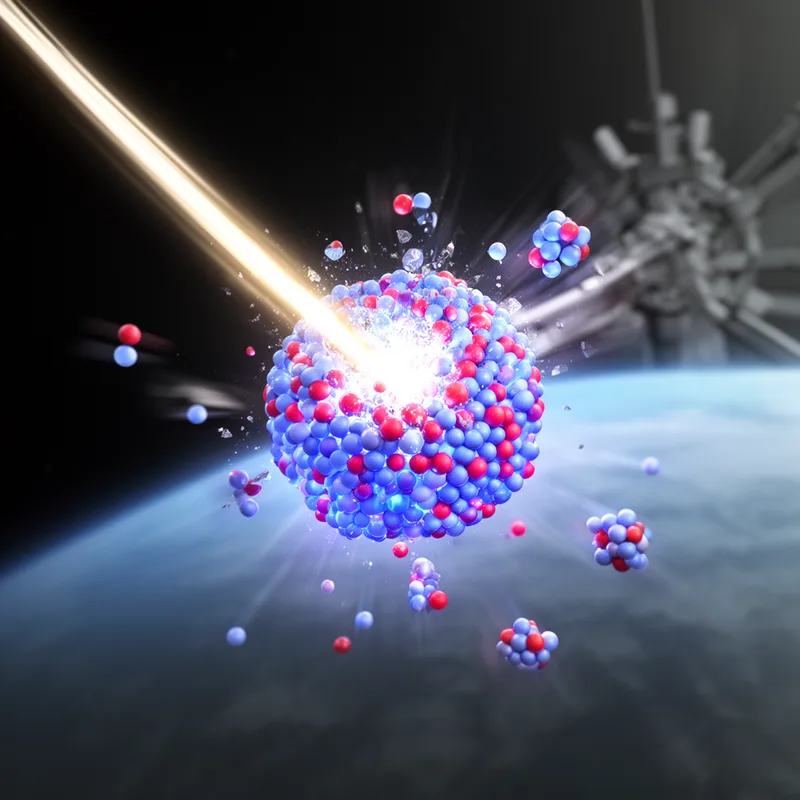
The process of spallation is crucial in certain nuclear reactions where a nucleus is broken apart by high-energy particles.
Surface Forms
Morphology
Etymology
Spallation comes from the verb spall, which means 'to break off into small pieces', so imagine a nucleus hit and sending tiny bits flying. So in nuclear science spallation is when a nucleus struck by a fast particle breaks up into several smaller pieces.