
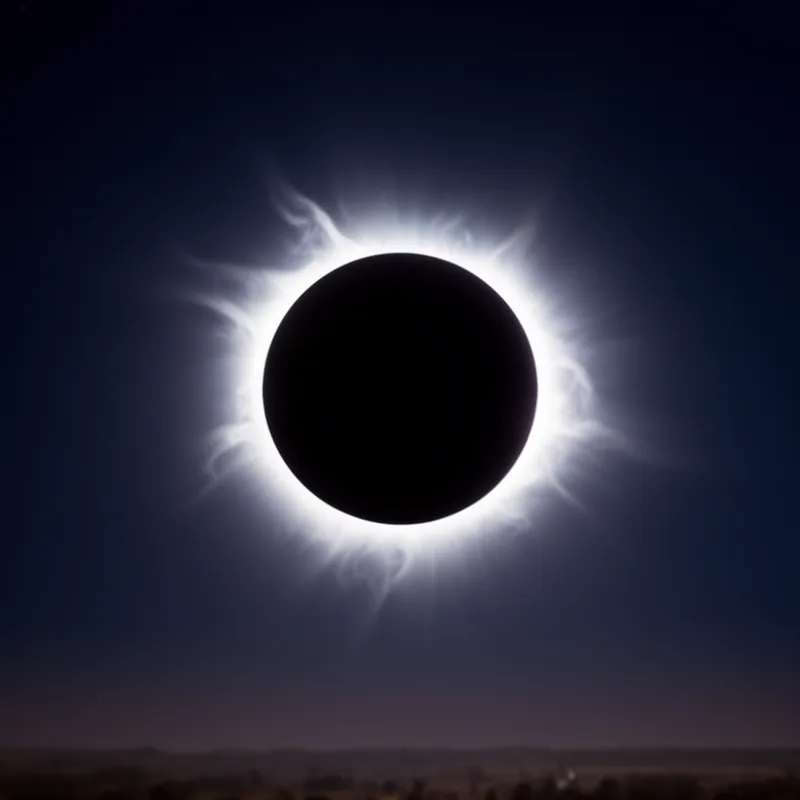
solar eclipse
 12
3.6
12
3.6

- noun
- /ˈsoʊlər ɪˈklɪps/
- During the solar eclipse, the sky darkened as the moon completely covered the sun.
- a total solar eclipse
- a partial solar eclipse
- an annular solar eclipse
Loading YouTube…
Watch on YouTubeSo the description would be compatible with a total solar eclipse.
- So the description would be compatible with a total solar eclipse.
- So there was the total solar eclipse that went across the Americas, Mexico, up into Canada.
- And in fact, to get started, what I thought I would do is to give you a sense of what the last total solar eclipse was like, which took place just last March.
- And so I was delighted and honored to share this total solar eclipse with close friends, new friends, the press, other media, social media.
- And during its peak of the solar eclipse is where you're going to be.
- the US election, the Paris Olympics, the total solar eclipse.
- But that is an alignment of planets akin to a total solar eclipse.
- I think she thinks she thought that the solar eclipse is some sign in revelations to the coming of Jesus Christ.
- Is the moon not in front of the sun on the solar eclipse Jack wagon?
Examples
-
Having never seen a total solar eclipse, I didn't know what to expect.
Academic text (2000) -
Nowadays, it is easy to precisely predict solar eclipses, and the information is highlighted through the media.
Academic text (2010) -
All anyone can talk about is the solar eclipse and we are part of it.
-
And we happened to see the solar eclipse together.
-
When exactly is this total solar eclipse due? - Four days' time.
-
I had to know when the next total solar eclipse would be.
Academic text (2000) -
As a result, many people can see a partial solar eclipse without effort.
Academic text (2000) -
A solar eclipse will occur on the 17th of this very month.
-
In the sky, the face of the moon obliterates the sun; it's a full solar eclipse.
Fiction book (1996) -
Once one experiences the rush of totality during a solar eclipse, one is forever trying to recapture it.
Academic text (2000)
Synonyms
 87
5.2
87
5.2
A time when one object, like the Moon, moves into another object's shadow and is hidden
 1
9.9
1
9.9
One object in the sky, like a moon, passes in front of another and hides it completely or partly
How Total

Surface Forms
Morphology
The meaning is directly compositional: 'solar' = relating to the sun and 'eclipse' = an obscuring event, so together they denote the sun being obscured. This is a predictable, cross-linguistically common compound pattern, so a B1 learner who knows both constituents will understand the term.
Etymology
The noun solar eclipse comes from a simple image: the moon moves in front of the sun, so the solar light is blocked and the sky grows dark. So, solar eclipse means 'an event when the sun is partly or completely blocked by the moon'.