
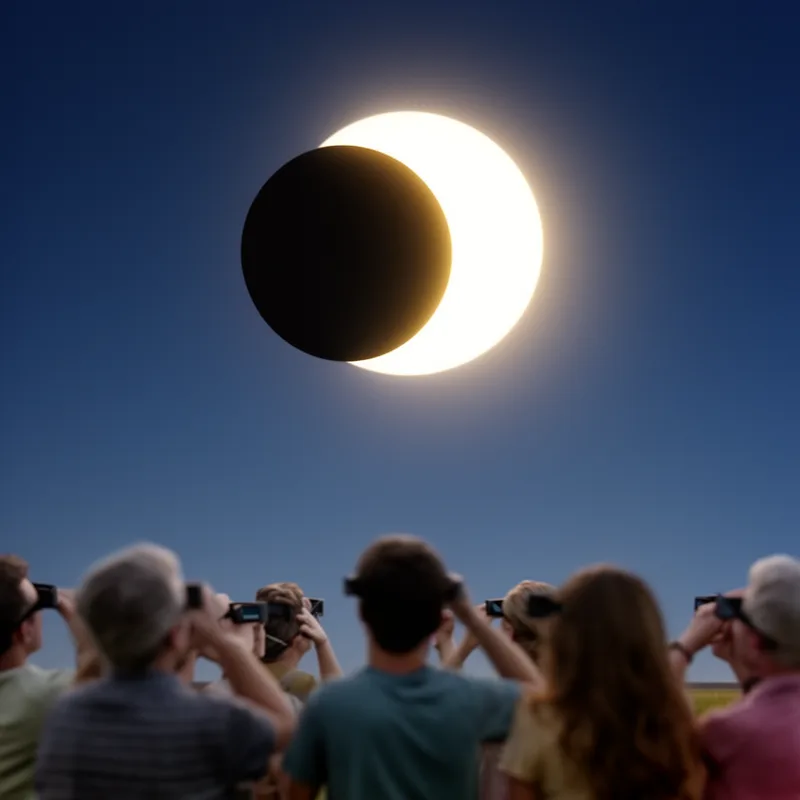
partial eclipse
 1
5.9
1
5.9

- noun
- /ˈpɑːrʃəl ɪˈklɪps/
- During the afternoon, townspeople gathered to watch the partial eclipse and marvel at the sky's changing colors.
- partial eclipse of the sun
- partial eclipse of the Moon
- see a partial eclipse
Loading YouTube…
Watch on YouTubeAnd I feel like that's what helps create this odd feeling around partial eclipses that they're, they're somehow stranger than total eclipses, that they're like almost more unsettling.
- And I feel like that's what helps create this odd feeling around partial eclipses that they're, they're somehow stranger than total eclipses, that they're like almost more unsettling.
Examples
-
The New Moon on October 2, 1959—which led to the first solar eclipse I ever saw—was followed by another New Moon and a partial eclipse in the Eastern Hemisphere on October 2, 1978.
Academic text (2002) -
And I feel like that's what helps create this odd feeling around partial eclipses that they're, they're somehow stranger than total eclipses, that they're like almost more unsettling.
-
There is a universe of difference, however, between the experiences of seeing a partial eclipse.
Academic text (2000) -
Another 125 parks from Alaska to Michigan may experience a partial eclipse based on weather and their distance from the event path.
Blog text (1) -
But every year, some place, maybe in Antarctica, there's going to be a partial eclipse and six months later another eclipse.
-
Many astronomers traveled to remote locations to observe the unique effects of a partial eclipse on the surrounding landscape.
-
As the partial eclipse occurred, people used special glasses to safely view the sun, ensuring they did not damage their eyes.
Synonyms
 87
5.2
87
5.2
A time when one object, like the Moon, moves into another object's shadow and is hidden
 1
9.9
1
9.9
One object in the sky, like a moon, passes in front of another and hides it completely or partly
Antonyms

- Specialized
3
4.4
A time when one object in the sky completely hides another from view
How Obscured
- Specialized
3
4.4

- Specialized
1
7.6
1
5.9
- Specialized
Surface Forms
Morphology
The phrase is fully compositional: 'partial' means 'only partly' and 'eclipse' means 'obscuring of one body by another', so a learner who knows both words can infer an eclipse that only partly obscures the body. This literal, modifier+noun pattern is cross-linguistically common and follows standard English composition, making it immediately comprehensible to B1 learners.
Etymology
The term partial eclipse paints a simple picture: partial means 'only part' and eclipse means 'covering', so it describes when one object covers only part of another and you can still see some of it. That's why it means 'only partly hidden'.