

silver hake
- noun
- /ˈsɪlvər heɪk/
- US
- The silver hake is a popular choice among chefs for its delicate flavor and flaky texture when cooked.
- Atlantic silver hake
- silver hake (Merluccius bilinearis)
- silver hake stocks
Examples
-
The area's leading finfish species in landings and value, respectively, were silver hake (whiting) and summer flounder (fluke).
Academic text (1990) -
Some prey species, such as Atlantic cod, silver hake, and Atlantic herring, are commercially valuable.
Academic text (2000) -
The potential for biological interaction may differ by stock of silver hake.
Academic text (2000) -
The impact of the expanding population of seals on the recovery of silver hake cannot be ascertained.
Academic text (2000) -
The New England fisheries chosen were Atlantic cod, silver hake, and Atlantic herring.
Academic text (2000) -
Silver hake consumed by pinnipeds and that targeted by the fishery were more similarly sized.
Academic text (2000) -
A portion of the silver hake taken by harbor seals is also of the size class that is typically discarded (15-25 cm).
Academic text (2000) -
Prey consumed included windowpane flounder, silver hake, sand lance, skates, and gadids.
Academic text (2000) -
Silver hake was the predominant year-round prey at 71% frequency of occurrence (FO).
Academic text (2000) -
Most silver hake mature between ages 2 (20-30 cm) and 3 (25-35 cm) (Helser et al., 1995; Mayo, 1998).
Academic text (2000)
Synonyms
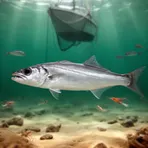
A fish called the silver hake that lives off the east coast of North America
Surface Forms
Morphology
The meaning is directly compositional: 'silver' describes a color/appearance and 'hake' names a fish, so 'silver hake' straightforwardly denotes a hake that is silver (a species/name of fish). This follows a common adjective+noun pattern found across languages, so a B1 learner who knows both constituents would readily infer the meaning.
Etymology
Silver hake is a name made from the fish's shiny, silvery skin and the word hake, a name fishermen used for a long sea 'fish'. So the name gives a simple picture — a 'silver' fish of the 'hake' kind — and today it just means that particular edible fish.

