
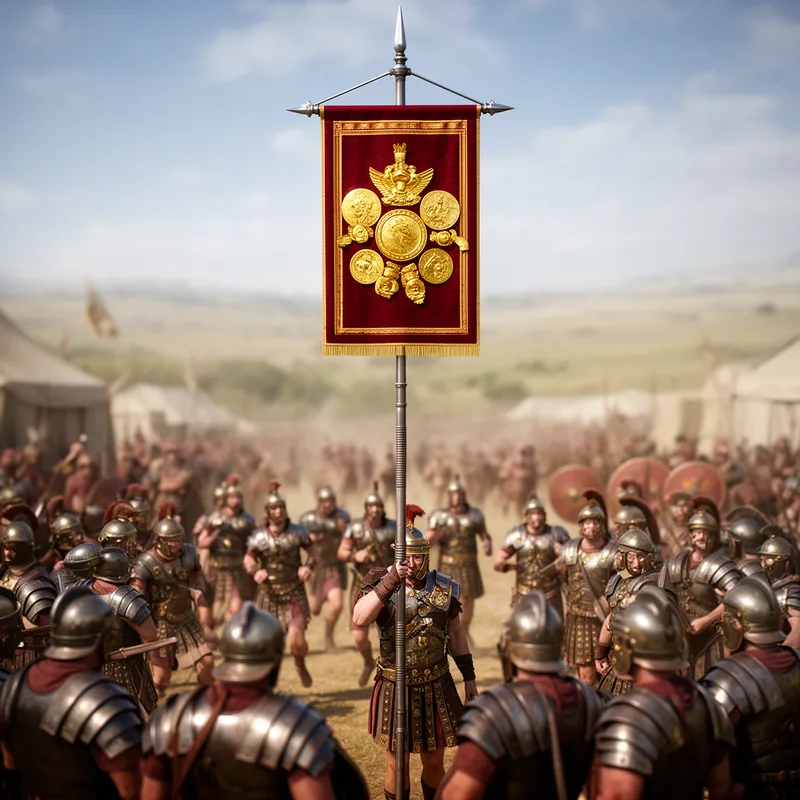
signum
- noun
- /ˈsɪɡnəm/
- Archaic
- The Roman general raised the signum to rally his troops before battle.
Examples
-
The signa were held in such high regard that, if they were taken by an enemy—as was the case of the signum of the general Varus in the famous battle of the Teutoburg Forest in A.D. 9—expeditions were sent out to recapture them.
Academic text (2007) -
Until last year, no imperial signum and only five fragments of military signa were known. "This is the first time remains of the shaft of a signum or of the objects that decorated the shafts have been found," says Roman military specialist Lisa Anderson of the A. Joukowsky Institute for Archaeology at Brown University.
Academic text (2007) -
I was also awarded the Signum Laudis.
-
Until last year, no imperial signum and only five fragments of military signa were known. "This is the first time remains of the shaft of a signum or of the objects that decorated the shafts have been found," says Roman military specialist Lisa Anderson of the A. Joukowsky Institute for Archaeology at Brown University.
Academic text (2007) -
Many soldiers wore their uniforms with pride as they approached their signum during the parade.
-
Each legion displayed its unique signum to symbolize its achievements and identity.
Synonyms

 41
5.0
41
5.0

A flag used as a symbol for a country, army, or group
 1
9.9
1
9.9
A small flag carried by a military group to show its identity

A flag used by Roman soldiers or the large top petal of pea flowers
Flags or banners carried in military and church ceremonies
Surface Forms
Etymology
Signum comes from the Latin signum, meaning 'sign' or 'mark'. Roman soldiers used a signum as a flag or banner to show their unit and call the men together, so a signum is a military standard or emblem used to identify and rally soldiers.