

to sieve
 1
5.8
1
5.8

- verb
- /sɪv/
- Next, the dried mud was mechanically disaggregated using a crushing machine, and finally, the mud was sieved to obtain particles of sizes under 500 microm.
- sieved soil
- sieved sample
Examples
-
The dried seeds were then ground in a kitchen blender and sieved through an iron sieve (200 m) to yield a fine powder.
Academic text (2008) -
Alan York of Golden Hooves Farm in Boonville, California, sieves compost tea into a spray tank (right).
Academic text (1996) -
So we're going to sieve out the water to keep that.
-
Water filters sieve sediment and other impurities from drinking water.
Academic text (2001) -
Close by in the pond, pink flamingos feed, using their highly specialized beaks to sieve the plankton-rich water.
Academic text (1994) -
Sawdust from a sawmill was sieved with a three mm mesh to minimize particle size.
Academic text (1999) -
The faecal samples were frozen at -20°C and later thawed and sieved.
Academic text (2015) -
You should sieve the flour before adding it to the cake mix to remove any lumps.
-
To prepare the sauce, you need to sieve the stock to eliminate any solid bits.
-
She decided to sieve the pasta to drain the water after it finished cooking.
Synonyms
 26
3.7
26
3.7
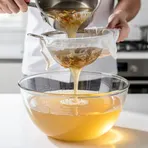
To remove solid bits from a liquid using a filter or sieve
 12
2.5
12
2.5
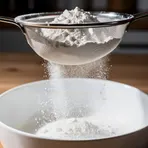
To put flour through a sieve to remove lumps
 5
4.2
5
4.2
To remove solid bits so a liquid becomes clear
 1
6.8
1
6.8
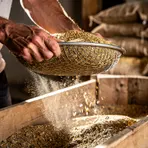
Remove small bits and dirt from grain using a sieve

 1
5.3
1
5.3
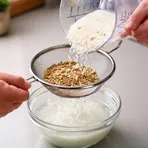
Remove unwanted bits from food or material by passing them through a screen
 1
9.9
1
9.9
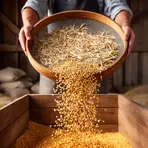
To sift grain or flour through a coarse sieve
Antonyms

Phrasal Verbs
Compounds


- Specialized
A tube made of cells joined end to end that carries nutrients in flowering plants and some algae
How Fine

Surface Forms
Etymology
The word sieve comes from an old German word meaning 'to sift' and is like the common English word sift. So to sieve something is to pass it through holes to separate the small parts from larger pieces.