
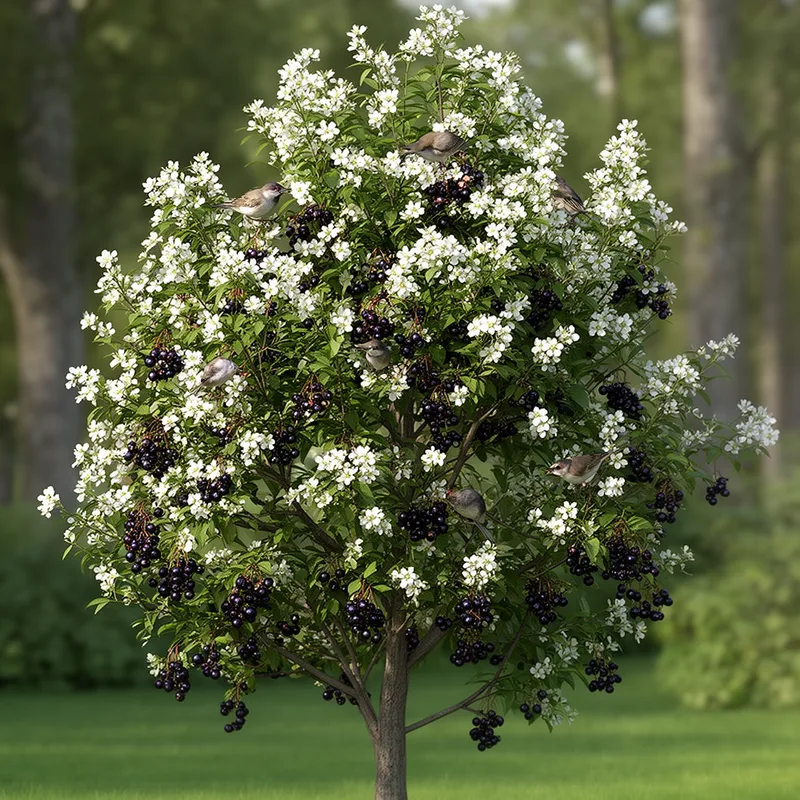
service tree
- noun
- /ˈsɜrvɪs tri/
- US
- Birds flocked to the service tree to eat its ripe, purplish fruit in late summer.
Examples
-
The service tree is often planted in gardens for both its flowers and edible berries.
-
In the forest, a cluster of service trees stood out with their brilliant white blossoms.
-
The service tree blooms beautifully in spring.
-
Many gardeners love the service trees for their fruit.
-
The service tree produces sweet, edible berries that attract many garden visitors.
-
In spring, the white flowers of the service tree create a stunning display.
-
Harvesting the ripe fruit from the service tree is a favorite activity in the late summer.
Synonyms


 1
9.2
1
9.2
A small tree or bush with white flowers and dark purple edible berries

A North American tree or shrub with white flowers and blue-black edible fruit

A tree or shrub with white flowers and dark blue berries you can eat

A small tree or bush with white spring flowers and dark berries you can eat

A North American tree or bush that loses its leaves and makes small edible berries

A small tree or bush from northwestern North America with creamy white flowers and small purple-red berries
Surface Forms
Morphology
service + tree
While 'tree' clearly signals a plant, the modifier 'service' does not transparently denote the species or the edible blue-black fruit to a learner who only knows the everyday meaning of 'service'. 'Service tree' is a conventional plant name (Amelanchier) whose specific botanical sense is lexicalized rather than compositionally predictable from its parts, so a B1 learner would not reliably infer the intended meaning.
Etymology
Service tree in North America is often called 'serviceberry' or 'sarvis', and one popular story says people named it because it flowers and fruits just as winter ends and people could go back to church 'services'. That's why the name makes you think of the tree's white flowers and sweet berries.